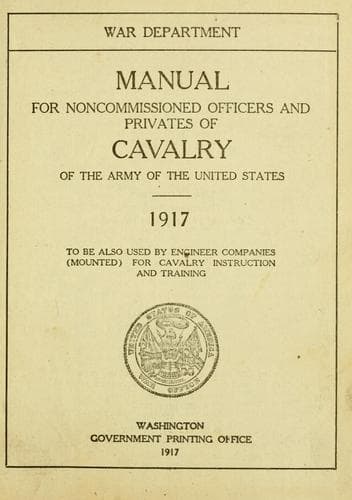
Manual for Noncommissioned Officers and Privates of Cavalry of the Army: of the United States 1917. To be also used by Engineer Companies (Mounted) for Cavalry Instruction and TrainingUnited States. War Department
History
Manual for Noncommissioned Officers and Privates of Cavalry of the Army: of the United States 1917. To be also used by Engineer Companies (Mounted) for Cavalry Instruction and Training
United States. War Department
United States. Army -- Handbooks, manuals, etc.
Except on account of imperative military reasons, Cavalry should not
leave camp for an hour or more after daylight. If grazing is depended
upon, this is especially necessary, since horses as a rule graze more
freely in the early morning when rested. Ample time should be allowed
after reville for grooming and feeding and thereafter for the men to
breakfast. All stable duties should be done quietly and without hurry
or confusion under the immediate supervision of troop and squadron
commanders. In each troop a man is detailed to walk the picket line
while grain is being fed, to look out for the horses generally and to
take off the feed or the nose bag of a horse as soon as he has
finished feeding.
The signals for striking tents (=the general=), for policing,
saddling, and beginning the march should be ordered personally by the
commanding officer and only when the duties pertaining to the previous
signal are completed.
=979.= =The march, its length and rate=: The average daily march of a
Cavalry column of the size of a squadron, or larger, is about 25 miles
when horses are in condition; when starting on long-distance marches
the rate per day for the first few days should be less than 20 miles
and gradually increased. These rules may necessarily be modified, even
when horses are not in fit condition, by reason of emergencies,
character of roads or weather, proximity of water, grazing, etc., but,
with these exceptions, the question of the =length= of the daily march
is one of good judgment and experience on the part of the commander.
The =gait= and =pace= of the daily march are influenced by both the
time the horse is to carry the load and the distance to be covered.
The quicker a march can be completed without forcing the less the
fatigue to both horse and man. Where the footing is good, the road
level, and other considerations do not hamper the column, after the
first or a subsequent halt, may advance first by leading dismounted,
then mount and walk, then trot, a short gallop (exceptional), then the
trot, followed by the walk to the next halt. No gait is to be
maintained continuously long enough to weary either horse or man,
neither must it be changed too frequently in long columns; but
whatever pace or gait is taken it should conform to the standards
(par. 279). The officer setting the pace should occasionally drop back
to observe its effect on the column, and veterinarians, if present,
should be habitually utilized for this purpose.
The walk, if the footing is good, should be at the rate of 4 miles per
hour, exclusive of halts; the trot at 8 miles per hour, so as to
facilitate posting; the gallop, a very exceptional gait even for small
commands, should be not faster than the maneuvering gallop (par. 236),
and its practicability will depend upon the training and condition of
the horses, since on long marches, unless accustomed to this gait with
packed saddles, the horses will soon break down.
Public-domain text, read in full here on John Shaqi.
Reviews
Reviews
No reviews yet
Be the first to share your thoughts on this work.
Elsewhere in the archive
Join the Discussion
Join the discussion
Sign in to leave a comment or review.
Sign InorCreate an account