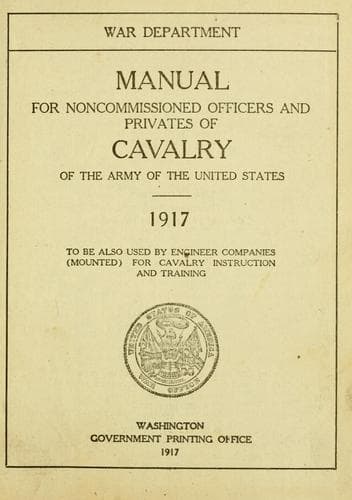
Manual for Noncommissioned Officers and Privates of Cavalry of the Army: of the United States 1917. To be also used by Engineer Companies (Mounted) for Cavalry Instruction and TrainingUnited States. War Department
History
Manual for Noncommissioned Officers and Privates of Cavalry of the Army: of the United States 1917. To be also used by Engineer Companies (Mounted) for Cavalry Instruction and Training
United States. War Department
United States. Army -- Handbooks, manuals, etc.
Very rarely, however, will the conditions allow the regular
arrangement of gaits indicated above. Rolling country, with ascents
and descents, stretches of hard or stony road or of mud, dust, or
sand, crossings of streams, etc., will ordinarily impose corresponding
changes of gait or pace on each of the small elements of the column as
it reaches them. To provide for this the troops in route column, when
so directed, take greater distances than prescribed in order to allow
for closing up at checks.
The commander must give this matter unremitting attention, since
normal route-order distances in column frequently entail discomfort to
the men and sometimes injuries to the horses which might have been
avoided.
Unless under exceptional circumstances, the commander of a marching
column will authorize each troop commander to so regulate the gait and
pace of his troop as to conform to that next in front, the gait and
pace of the leading troop being regulated by the commander himself.
This results in each troop changing to the trot, walk, leading
dismounted, etc., at the same place at which the leading troop did,
and although regulation distances, are frequently exceeded, the
tendency on all stretches of good road is to close on the leading
troop of the column. With care this method of marching should result
in enabling each troop in the column to move with almost the same
regularity and freedom from checks as though it were in the lead.
The fast rate of march that can be expected of small detachments and
of single riders can not be demanded of a long Cavalry column, and as
the command increases in size the rate of march will decrease. The
regulation gaits being, at the walk, 4 miles, the trot, 8 miles,
Cavalry should be able to make, including halts, 5 miles per hour or
better. This rate can be maintained for daily marches of 25 miles
under ordinary conditions for a week at a time, after which a day of
rest should be allowed before continuing the march.
=980.= =Formations=: The habitual formation for marches is route order
in column of fours (par. 754). When the roads are unsuitable or the
command is small, column of twos or troopers is permissible. To
economize road space in large commands =double column= or parallel
columns should be used if practicable. Squadrons in regiment and
troops in squadrons alternate in leading, the rule being that the one
in front one day automatically follows in rear the next day.
=981.= =Halts=: The first half hour of a march should be made at a
walk and the first halt of 10 or 15 minutes toward the end of the
first hour after starting; it should, if possible, be preceded by a
short trot in order to make apparent any faulty adjustment of
equipment. This halt gives an opportunity for the horses to stale and
for the troopers to attend to the calls of nature, to tighten girths,
and to adjust saddles, equipment, and clothing.
Public-domain text, read in full here on John Shaqi.
Manual for Noncommissioned Officers and Privates of Cavalry of the Army: of the United States 1917. To be also used by Engineer Companies (Mounted) for Cavalry Instruction and Training — John Shaqi
Reviews
Reviews
No reviews yet
Be the first to share your thoughts on this work.
Elsewhere in the archive
Join the Discussion
Join the discussion
Sign in to leave a comment or review.
Sign InorCreate an account