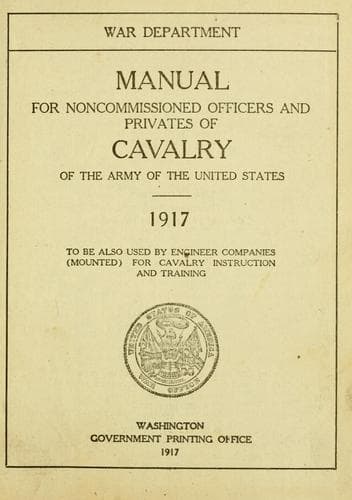
Manual for Noncommissioned Officers and Privates of Cavalry of the Army: of the United States 1917. To be also used by Engineer Companies (Mounted) for Cavalry Instruction and TrainingUnited States. War Department
History
Manual for Noncommissioned Officers and Privates of Cavalry of the Army: of the United States 1917. To be also used by Engineer Companies (Mounted) for Cavalry Instruction and Training
United States. War Department
United States. Army -- Handbooks, manuals, etc.
The battle sight is the open sight seen when the leaf is laid flat. It
is adjusted for a range of 547 yards. It is intended to be used in
battle when you get nearer to the enemy than 600 yards. Always aim at
the belt of a standing enemy, or just below him if he is kneeling,
sitting, or lying. On the target range this sight is used for rapid
fire. With it the rifle shoots about 2 feet high at ranges between 200
and 400 yards, so you must aim below the figure on the target "D."
Find out in your instruction practice just how much you must aim below
to hit the figure.
=Section 6. Trigger squeeze.=
Use the first joint of the forefinger to squeeze the trigger. It is
the most sensitive and best controlled portion of the body. As you
place the rifle to your shoulder, squeeze the trigger so as to pull it
back about one-eighth of an inch, thus taking up the safety portion or
slack of the pull. Then contract the trigger finger gradually, slowly
and steadily increasing the pressure on the trigger while the aim is
being perfected. Continue the gradual increase of pressure so that
when the aim has become exact the additional pressure required to
release the point of the sear can be given almost insensibly and
without causing any deflection of the rifle. Put absolutely all your
mind and will power into holding the rifle steady and squeezing the
trigger off without disturbing the aim. Practice squeezing the trigger
in this way every time you have your rifle in your hand until you can
surely and quickly do it without a suspicion of a jerk.
By practice the soldier becomes familiar with the trigger squeeze of
his rifle, and knowing this he is able to judge at any time, within
limits, what additional pressure is required for its discharge. By
constant repetition of this exercise he should be able finally to
squeeze the trigger to a certain point beyond which the slightest
movement will release the sear. Having squeezed the trigger to this
point the aim is corrected, and when true the additional pressure is
applied and the discharge follows and the bullet flies true to the
mark.
=Section 7. Firing positions.=
When in ranks at close order the positions are those described in the
Cavalry Drill Regulations. When in extended order or when firing alone
these positions may be modified somewhat to better suit the
individual. The following remarks on the various positions are offered
as suggestions whereby steady positions may be learned by the soldier.
Public-domain text, read in full here on John Shaqi.
Reviews
Reviews
No reviews yet
Be the first to share your thoughts on this work.
Elsewhere in the archive
Join the Discussion
Join the discussion
Sign in to leave a comment or review.
Sign InorCreate an account