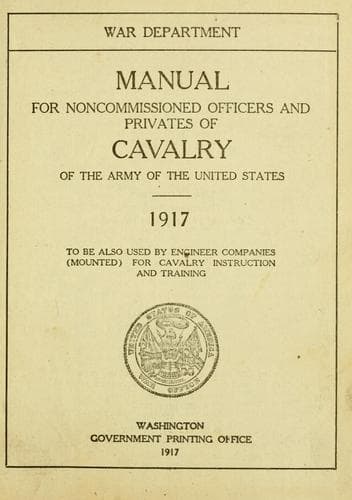
Manual for Noncommissioned Officers and Privates of Cavalry of the Army: of the United States 1917. To be also used by Engineer Companies (Mounted) for Cavalry Instruction and TrainingUnited States. War Department
History
Manual for Noncommissioned Officers and Privates of Cavalry of the Army: of the United States 1917. To be also used by Engineer Companies (Mounted) for Cavalry Instruction and Training
United States. War Department
United States. Army -- Handbooks, manuals, etc.
+--------+--------------+-------------+
| | Correction | Correction |
| Range. | by a change | by a change |
| | in elevation | in windage |
| | of 25 yards. | of 1 point. |
+--------+--------------+-------------+
| | | |
|_Yards._| _Inches._ | _Inches._ |
| 100 | 0.72 | 4 |
| 200 | 1.62 | 8 |
| 300 | 2.79 | 12 |
| 400 | 4.29 | 16 |
| 500 | 6.22 | 20 |
| 600 | 8.59 | 24 |
| 800 | 15.43 | 32 |
| 1,000 | 25.08 | 40 |
+--------+--------------+-------------+
An easy rule to remember the windage correction by is: "A change of 1
point of wind changes the point of impact 4 inches for every 100 yards
of range."
Copy this table and take it to the range with you.
Example of sight adjustment: Suppose you are firing at 500 yards. The
first two or three shots show you that your shots are hitting about a
foot below and a foot to the right of the center of the bull's-eye.
From the above table you will see that if you will raise your sight 50
yards and move the wind gauge half a point to the left the rifle will
be sighted so that if you aim correctly the bullets will hit well
inside the bull's-eye.
=Section 4. Aiming.=
=Open sight=: Always align your sights with the front sight squarely
in the middle of the "U" or notch of the rear sight, and the top of
the front sight even with the upper corners of the "U." (See fig. 1.)
All the sights on the rifle except the peep sight are open sights.
[Illustration: FIGURE 1.]
=Peep sight=: Always center the tip of the front sight in the center
of the peephole when aiming with this sight. (See fig. 2.)
[Illustration: FIGURE 2.]
Always aim below the bull's-eye. Never let your front sight appear to
touch the bull's eye in aiming. Try to see the same amount of white
target between the top of the front sight and the bottom of the
bull's-eye each time. The eye must be focused on the bull's-eye or
mark and not on the front or rear sight.
Look at figures 1 and 2 until your eye retains the memory of them,
then try to duplicate the picture every time you aim. Aim
consistently, always the same. Never change your aim; change your
sight adjustment if your shots are not hitting in the right place.
Many shots have been wasted when the point of aim has been moved to
what the firer thought was the necessary change on the target, instead
of changing the sights according to the table on page 191.
=Section 5. Battle sight.=
Public-domain text, read in full here on John Shaqi.
Reviews
Reviews
No reviews yet
Be the first to share your thoughts on this work.
Elsewhere in the archive
Join the Discussion
Join the discussion
Sign in to leave a comment or review.
Sign InorCreate an account