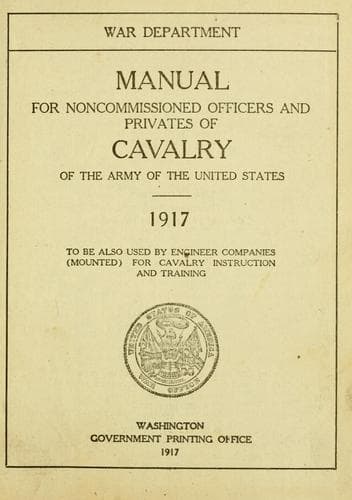
Manual for Noncommissioned Officers and Privates of Cavalry of the Army: of the United States 1917. To be also used by Engineer Companies (Mounted) for Cavalry Instruction and TrainingUnited States. War Department
History
Manual for Noncommissioned Officers and Privates of Cavalry of the Army: of the United States 1917. To be also used by Engineer Companies (Mounted) for Cavalry Instruction and Training
United States. War Department
United States. Army -- Handbooks, manuals, etc.
=Prone position and use of the gun sling=: To adjust the sling for
firing, unhook the straight strap of the sling and let it out as far
as it will go. Adjust the loop so that when stretched along the bottom
of the stock its rear end (bight) comes about opposite the comb of the
stock. A small man needs a longer loop than a tall man. Lie down
facing at an angle of about 60° to the right of the direction of the
target. Spread the legs as wide apart as they will go with comfort.
Thrust the left arm through between the rifle and the sling, and then
back through the loop of the sling, securing the loop, by means of the
keeper, around the upper left arm as high up as it will go. Pass the
hand under and then over the sling from the left side, and grasp the
stock and handguard just in rear of the lower band. Raise the right
elbow off the ground, rolling slightly over on the left side. Place
the butt to the shoulder and roll back into position, clamping the
rifle hard and steady in the firing position. The rifle should rest
deep down in the palm of the left hand with fingers almost around the
handguard. Shift the left palm a little to the right or left until the
rifle stands perfectly upright (no cant) without effort. The left
elbow should rest on the ground directly under the rifle, and right
elbow on the ground about 5 inches to the right of a point directly
under the stock. In this position the loop of the sling, starting at
the lower band, passes to the right of the left wrist, and thence
around the left upper arm. The loop should be so tight that about 50
pounds tension is placed on it when the position is assumed. This
position is uncomfortable until practiced, when it quickly ceases to
be uncomfortable. It will be steadier if small holes can be found or
dug in the ground for the elbows. In this position the sling binds the
left forearm to the rifle and to the ground so that it forms a dead
rest for the rifle, with a universal joint, the wrist, at its upper
end. Also the rifle is so bound to the shoulder that the recoil is not
felt at all. This is the steadiest of all firing positions.
The gun sling can also be used in this manner with advantage in the
other positions.
=Section 8. Calling the shot.=
It is evident that the sights should be so adjusted at each range that
the rifle will hit where you aim. In order to determine that the
sights are so adjusted, it is necessary that you shall know each time
just where you were aiming on the target at the instant your rifle was
discharged. If you know this and your rifle hits this point, your
rifle is correctly sighted. If your shot does not hit near this point,
you should change your sight adjustment in accordance with the table
of sight corrections on page 191.
Public-domain text, read in full here on John Shaqi.
Reviews
Reviews
No reviews yet
Be the first to share your thoughts on this work.
Elsewhere in the archive
Join the Discussion
Join the discussion
Sign in to leave a comment or review.
Sign InorCreate an account