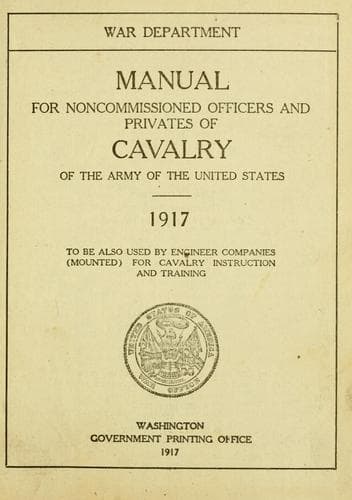
Manual for Noncommissioned Officers and Privates of Cavalry of the Army: of the United States 1917. To be also used by Engineer Companies (Mounted) for Cavalry Instruction and TrainingUnited States. War Department
History
Manual for Noncommissioned Officers and Privates of Cavalry of the Army: of the United States 1917. To be also used by Engineer Companies (Mounted) for Cavalry Instruction and Training
United States. War Department
United States. Army -- Handbooks, manuals, etc.
No man can hold absolutely steady. The rifle trembles slightly, and
the sights seem to wabble and move over the target. You try to squeeze
off the last ounce of the trigger squeeze just as the sights move to
the desired alignment under the bull's-eye. At this instant, just
before the recoil blots out a view of the sights and target, you
should catch with your eye a picture, as it were, of just where on the
target your sights were aligned, and call to yourself or to the coach
this point. This point is where your shot should strike if your sights
are correctly adjusted and if you have squeezed the trigger without
disturbing your aim. Until a man can call his shots he is not a good
shot, for he can never tell if his rifle is sighted right or not, or
if a certain shot is a good one or only the result of luck.
=Section 9. Coordination.=
Good marksmanship consists in learning thoroughly the details of--
Holding the rifle in the various positions.
Aiming.
Squeezing the trigger.
Calling the shot.
Adjusting the sights.
And when these have been mastered in detail then the coordination of
them in the act of firing. This coordination consists in putting
absolutely all of one's will power into an effort to hold the rifle
steadily, especially in getting it to steady down when the aim is
perfected; in getting the trigger squeezed off easily at the instant
the rifle is steadiest and the aim perfected; in calling the shot at
this instant; and if the shot does not hit near the point called, then
in adjusting the sights the correct amount so that the rifle will be
sighted to hit where you aim.
=Section 10. Advice to riflemen.=
Before going to the range clean the rifle carefully, removing every
trace of oil from the bore. This can best be done with a rag saturated
with gasoline. Put a light coat of oil on the bolt and cams. Blacken
the front and rear sights with smoke from a burning candle or camphor
or with liquid sight black.
Look through the bore and see that there is no obstruction in it.
Keep the rifle off the ground; the stock may absorb dampness, the
sights may be injured, or the muzzle filled with dirt.
Watch your hold carefully and be sure to know where the line of sight
is at discharge. It is only in this way that the habit of calling
shots, which is essential to good shooting, can be acquired.
Study the conditions, adjust the sling, and set the sight before going
to the firing point.
Look at the sight adjustment before each shot and see that it has not
changed.
If sure of your hold and if the hit is not as called, determine and
make FULL correction in elevation and windage to put the next shot in
the bull's-eye.
Keep a written record of the weather conditions and the corresponding
elevation and windage for each day's firing.
Less elevation will generally be required on hot days; on wet days; in
a bright sunlight; with a 6 o'clock wind; or with a cold barrel.
Public-domain text, read in full here on John Shaqi.
Reviews
Reviews
No reviews yet
Be the first to share your thoughts on this work.
Elsewhere in the archive
Join the Discussion
Join the discussion
Sign in to leave a comment or review.
Sign InorCreate an account