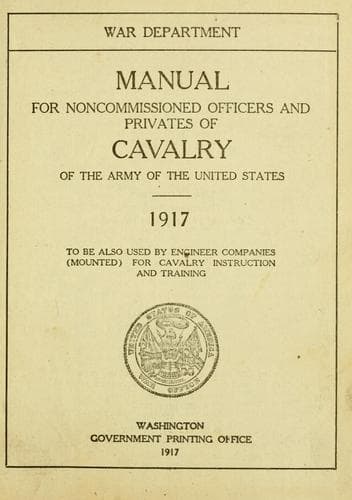
Manual for Noncommissioned Officers and Privates of Cavalry of the Army: of the United States 1917. To be also used by Engineer Companies (Mounted) for Cavalry Instruction and TrainingUnited States. War Department
History
Manual for Noncommissioned Officers and Privates of Cavalry of the Army: of the United States 1917. To be also used by Engineer Companies (Mounted) for Cavalry Instruction and Training
United States. War Department
United States. Army -- Handbooks, manuals, etc.
More elevation will generally be required on cold days; on very dry
days; with a 12 o'clock wind; with a hot barrel; in a dull or cloudy
light.
The upper band should not be tight enough to bind the barrel.
Do not put a cartridge into the chamber until ready to fire. Do not
place cartridges in the sun. They will get hot and shoot high.
Do not rub the eyes--especially the sighting eye.
In cold weather warm the trigger hand before shooting.
After shooting, clean the rifle carefully and then oil it to prevent
rust.
Have a strong, clean cloth that will not tear and jam, properly cut to
size, for use in cleaning.
Always clean the rifle from the breech, using a brass cleaning rod
when available. An injury to the rifling at the muzzle causes the
piece to shoot very irregularly.
Regular physical exercise, taken systematically, will cause a marked
improvement in shooting.
Frequent practice of the "Position and aiming drills" and gallery
practice are of the greatest help in preparing for shooting on the
range.
=Rapid firing=: Success in rapid firing depends upon catching a quick
and accurate aim, holding the piece firmly and evenly, and in
squeezing the trigger without a jerk.
In order to give as much time as possible for aiming accurately, the
soldier must practice taking position, loading with the clip, and
working the bolt, so that no time will be lost in these operations.
With constant practice all these movements may be made quickly and
without false motions.
When the bolt handle is raised, it must be done with enough force to
start the shell from the chamber; and when the bolt is pulled back it
must be with sufficient force to throw the empty shell well away from
the chamber and far enough to engage the next cartridge.
In loading, use force enough to load each cartridge with one motion.
The aim must be caught quickly, and, once caught, must be held and the
trigger squeezed steadily. Rapid firing, as far as holding, aim, and
squeezing the trigger are concerned, should be done with all the
precision of slow fire. The gain in time should be in getting ready to
fire, loading, and working the bolt.
=Firing with rests=: In order that the shooting may be uniform the
piece should always be rested at the same point.
=Section 11. The course in small-arms firing.=
The course in small-arms firing consists of--
(_a_) Nomenclature and care of rifle.
(_b_) Sighting drills.
(_c_) Position and aiming drills.
(_d_) Deflection and elevation correction drills.
(_e_) Gallery practice.
(_f_) Estimating distance drill.
(_g_) Individual known-distance firing, instruction practice.
(_h_) Individual known-distance firing, record practice.
(_i_) Long-distance practice.
(_j_) Practice with telescopic sights.
(_k_) Instruction combat practice.
(_l_) Combat practice.
(_m_) Proficiency test.
The regulations governing these are found in Small Arms Firing Manual,
1913. There should be several copies of this manual in every troop.
Public-domain text, read in full here on John Shaqi.
Reviews
Reviews
No reviews yet
Be the first to share your thoughts on this work.
Elsewhere in the archive
Join the Discussion
Join the discussion
Sign in to leave a comment or review.
Sign InorCreate an account