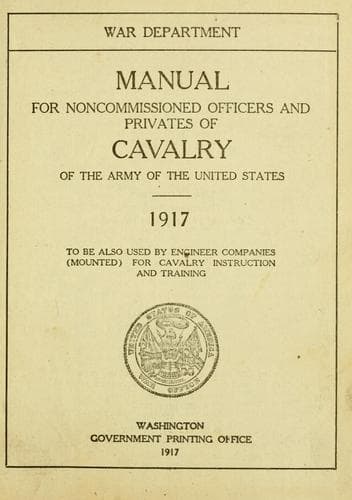
Manual for Noncommissioned Officers and Privates of Cavalry of the Army: of the United States 1917. To be also used by Engineer Companies (Mounted) for Cavalry Instruction and TrainingUnited States. War Department
History
Manual for Noncommissioned Officers and Privates of Cavalry of the Army: of the United States 1917. To be also used by Engineer Companies (Mounted) for Cavalry Instruction and Training
United States. War Department
United States. Army -- Handbooks, manuals, etc.
(_b_) =How to cock the revolver=: The revolver should be cocked by
putting the thumb on the hammer at as nearly a right angle to the
hammer as possible, and by the action of the thumb muscles alone
bringing the hammer back to the position of full cock. Some men with
large hands are able to cock the revolver with the thumb while holding
it in the position of aim or raise pistol. Where the soldier's hand is
small this can not be done, and in this case it assists the operation
to give the revolver a slight tilt to the right and upward (to the
right). Particular care should be taken that the forefinger is clear
of the trigger or the cylinder will not revolve. Jerking the revolver
forward while holding the thumb on the hammer will not be permitted.
=141.= =Position, and aiming drills, dismounted=: For this instruction
the squad will be formed with an interval of 1 pace between files.
Black pasters to simulate bull's-eyes will be pasted opposite each man
on the barrack or other wall, from which the squad is 10 paces
distant.
The squad being formed as described above, the instructor gives the
command: 1. =Raise=, 2. =Pistol= (par. 147, Cavalry Drill
Regulations), and cautions, "=Position and aiming drill, dismounted.="
The men take the positions described in paragraph 136, except that
the pistol is held at "Raise pistol."
[Illustration: PLATE VI.]
The instructor cautions, "Trigger squeeze exercise." At the command
=READY=, cock the weapon as described in paragraph 140. At the
command, 1. =Squad=, 2. =FIRE=, slowly extend the arm till it is
nearly horizontal, the pistol directed at a point about 6 inches below
the bull's-eye. At the same time put the forefinger inside the trigger
guard and gradually "feel" the trigger. Inhale enough air to
comfortably fill the lungs and gradually raise the piece until the
line of sight is directed at the point of aim, i. e., just below the
bull's-eye at 6 o'clock. While the sights are directed upon the mark,
gradually increase the pressure on the trigger until it reaches that
point where the slightest additional pressure will release the sear.
Then, when the aim is true, the additional pressure necessary to fire
the piece is given so smoothly as not to derange the alignment of the
sights. The weapon will be held on the mark for an instant after the
hammer falls and the soldier will observe what effect, if any, the
squeezing of the trigger has had on his aim.
It is impossible to hold the arm perfectly still, but each time the
line of sight is directed on the point of aim a slight additional
pressure is applied to the trigger until the piece is finally
discharged at one of the moments when the sights are correctly aligned
upon the mark.
Public-domain text, read in full here on John Shaqi.
Reviews
Reviews
No reviews yet
Be the first to share your thoughts on this work.
Elsewhere in the archive
Join the Discussion
Join the discussion
Sign in to leave a comment or review.
Sign InorCreate an account