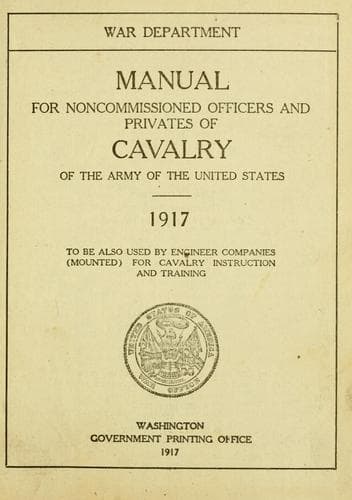
Manual for Noncommissioned Officers and Privates of Cavalry of the Army: of the United States 1917. To be also used by Engineer Companies (Mounted) for Cavalry Instruction and TrainingUnited States. War Department
History
Manual for Noncommissioned Officers and Privates of Cavalry of the Army: of the United States 1917. To be also used by Engineer Companies (Mounted) for Cavalry Instruction and Training
United States. War Department
United States. Army -- Handbooks, manuals, etc.
When the soldier has become proficient in taking the proper position,
the trigger squeeze should be executed at will. The instructor
prefaces the preparatory command by "At will" and give the command
=HALT= at the conclusion of the exercise, when the soldier will return
to the position of "Raise pistol."
At first this exercise should be executed with deliberation, but
gradually the soldier will be taught to catch the aim quickly and to
lose no time in beginning the trigger squeeze and bringing it to the
point where the slightest additional pressure will release the sear.
REMARKS.--In service few opportunities will be offered for slow aimed
fire with the pistol or revolver, although use will be made of the
weapon under circumstances when accurate pointing and rapid
manipulation are of vital importance.
In delivering a rapid fire, the soldier must keep his eyes fixed upon
the mark and, after each shot, begin a steadily increasing pressure on
the trigger, trying at the same time to get the sights as nearly on
the mark as possible before the hammer again falls. The great
difficulty in quick firing with the pistol lies in the fact that when
the front sight is brought upon the mark the rear sight is often found
to be outside the line joining the eye with the mark. This tendency to
hold the pistol obliquely can be overcome only by a uniform manner of
holding and pointing. This uniformity is to be attained only by
acquiring a grip which can be taken with certainty each time the
weapon is fired. It is this circumstance which makes the position and
aiming drills so important. The soldier should constantly practice
pointing the pistol until he acquires the ability to direct it on the
mark in the briefest interval of time and practically without the aid
of sights.
The soldier then repeats the exercises with the pistol in the left
hand, the left side being turned toward the target.
=142.= =To draw and fire quickly--Snap shooting.=--With the squad
formed as described in paragraph 141 except that the pistol is in the
holster and the flap, if any, buttoned, the instructor cautions
"Quick-fire exercise." And gives the command, 1. =SQUAD=, 2. =FIRE.=
At this command each soldier, keeping his eye on the target, quickly
draws his pistol, unlocks it, thrusts it toward the target, squeezes
the trigger, and at the instant the weapon is brought in line with the
eye and the objective increases the pressure, releasing the sear. To
enable the soldier to note errors in pointing, the weapon will be
momentarily held in position after the fall of the hammer. Efforts at
deliberate aiming in this exercise must be discouraged.
Remarks under paragraph 141 are specially applicable also to this type
of fire. When the soldier has become proficient in the details of this
exercise, it should be repeated at will; the instructor cautions, "At
will; quick-fire exercise." The exercise should be practiced until the
mind, the eye, and trigger finger act in unison.
Public-domain text, read in full here on John Shaqi.
Reviews
Reviews
No reviews yet
Be the first to share your thoughts on this work.
Elsewhere in the archive
Join the Discussion
Join the discussion
Sign in to leave a comment or review.
Sign InorCreate an account