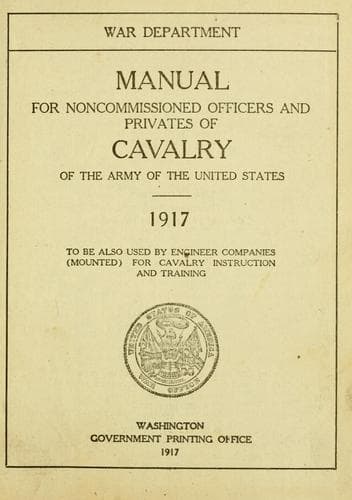
Manual for Noncommissioned Officers and Privates of Cavalry of the Army: of the United States 1917. To be also used by Engineer Companies (Mounted) for Cavalry Instruction and TrainingUnited States. War Department
History
Manual for Noncommissioned Officers and Privates of Cavalry of the Army: of the United States 1917. To be also used by Engineer Companies (Mounted) for Cavalry Instruction and Training
United States. War Department
United States. Army -- Handbooks, manuals, etc.
=230.= The commander of the guard will be notified of the presence in
camp or garrison of all persons entitled to the compliment except
general officers of the Army, the commanding officer, and the officer
of the day. Members of the guard will salute all persons entitled to
the compliment and all officers in the military or naval service of
foreign powers, officers of the Army, Navy, and Marine Corps, officers
of volunteers, and officers of militia when in uniform.
GENERAL RULES CONCERNING GUARD DUTY.
=232.= _Eighty-fifth article of war._--* * * Any person subject to
military law, except an officer, who is found drunk on duty shall be
punished as a court-martial may direct.
=233.= All material instructions given to a member of the guard by an
officer having authority will be promptly communicated to the
commander of the guard by the officer giving them.
=234.= Should the guard be formed, soldiers will fall in ranks under
arms. At roll call each man, as his name or number and relief are
called, will answer "Here," and come to an order arms.
=235.= Whenever the guard or a relief is dismissed, each member not
at once required for duty will place his rifle in the arm racks, if
they be provided, and will not remove it therefrom unless he requires
it in the performance of some duty.
=236.= Without permission from the commander of the guard, members of
the main guard, except orderlies, will not leave the immediate
vicinity of the guardhouse. Permission to leave will not be granted
except in cases of necessity.
=237.= Members of the main guard, except orderlies, will not remove
their accouterments or clothing without permission from the commander
of the guard. (Par. 66.)
=Section 15. Prisoners.=
=238.= Articles of war 69, 70, 71, 72, and 73 have special reference
to the confinement of prisoners and should be carefully borne in mind.
=239.= The commander of the guard will place a civilian in confinement
on an order from higher authority only, unless such civilian is
arrested while in the act of committing some crime within the limits
of the military jurisdiction, in which case the commanding officer
will be immediately notified.
=240.= Except as provided in the sixty-eighth article of war, or when
restraint is necessary, no soldier will be confined without the order
of an officer, who shall previously inquire into his offense. (=A. R.
930.=)
=241.= An officer ordering a soldier into confinement will send, as
soon as practicable, a written statement, signed by himself, to the
commander of the guard, setting forth the name, company, and regiment
of such soldier, and a brief statement of the alleged offense. It is a
sufficient statement of the offense to give the number and article of
war under which the soldier is charged.
Public-domain text, read in full here on John Shaqi.
Reviews
Reviews
No reviews yet
Be the first to share your thoughts on this work.
Elsewhere in the archive
Join the Discussion
Join the discussion
Sign in to leave a comment or review.
Sign InorCreate an account