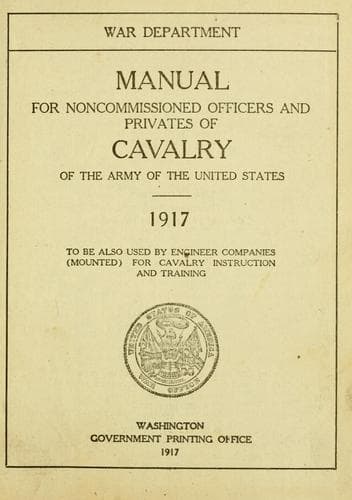
Manual for Noncommissioned Officers and Privates of Cavalry of the Army: of the United States 1917. To be also used by Engineer Companies (Mounted) for Cavalry Instruction and TrainingUnited States. War Department
History
Manual for Noncommissioned Officers and Privates of Cavalry of the Army: of the United States 1917. To be also used by Engineer Companies (Mounted) for Cavalry Instruction and Training
United States. War Department
United States. Army -- Handbooks, manuals, etc.
=224.= Between reveille and retreat, the following persons are
entitled to the compliment: The President; sovereign or chief
magistrate of a foreign country and members of a royal family; Vice
President; President and President pro tempore of the Senate; American
and foreign ambassadors; members of the Cabinet; Chief Justice;
Speaker of the House of Representatives; committees of Congress
officially visiting a military post; governors within their respective
States and Territories; governors general; Assistant Secretary of War
officially visiting a military post; all general officers of the Army;
general officers of foreign services visiting a post; naval, marine,
volunteer, and militia officers in the service of the United States
and holding the rank of general officer; American or foreign envoys or
ministers; ministers accredited to the United States; chargés
d'affaires accredited to the United States; consuls general accredited
to the United States; commanding officer of the post or camp; officer
of the day.
=225.= The relative rank between officers of the Army and Navy is as
follows: General with admiral, lieutenant general with vice admiral,
major general with rear admiral, brigadier general with commodore,[14]
colonel with captain, lieutenant colonel with commander, major with
lieutenant commander, captain with lieutenant, first lieutenant with
lieutenant (junior grade), second lieutenant with ensign. (A. R. 12.)
[Footnote 14: The grade of commodore ceased to exist as a
grade on the active list of the Navy of the United States on
Mar. 3, 1899. By section 7 of the act of Mar. 3, 1899, the
nine junior rear admirals are authorized to receive the pay
and allowances of a brigadier general of the Army.]
=226.= Sentinels will not be required to memorize paragraph 224, and,
except in the cases of general officers of the Army, the commanding
officer and the officer of the day will be advised in each case of the
presence in camp or garrison of persons entitled to the compliment.
=227.= Guards will turn out and present arms when the national or
regimental colors or standards, not cased, are carried past by a guard
or an armed party. This rule also applies when the party carrying the
colors is at drill. If the drill is conducted in the vicinity of the
guardhouse, the guard will be turned out when the colors first pass,
and not thereafter.
=228.= In case the remains of a deceased officer or soldier are
carried past, the guard will turn out and present arms.
=229.= In time of war all guards will turn out under arms when armed
parties, except troops at drill and reliefs or detachments of the
guard, approach their post. (See Par. 53.)
Public-domain text, read in full here on John Shaqi.
Reviews
Reviews
No reviews yet
Be the first to share your thoughts on this work.
Elsewhere in the archive
Join the Discussion
Join the discussion
Sign in to leave a comment or review.
Sign InorCreate an account