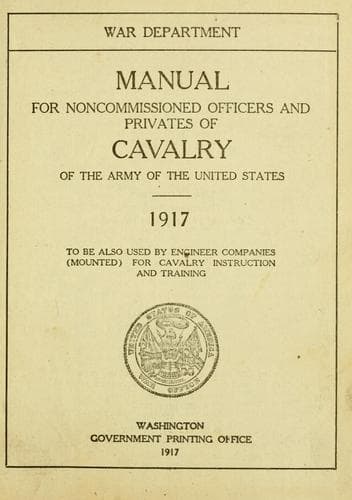
Manual for Noncommissioned Officers and Privates of Cavalry of the Army: of the United States 1917. To be also used by Engineer Companies (Mounted) for Cavalry Instruction and TrainingUnited States. War Department
History
Manual for Noncommissioned Officers and Privates of Cavalry of the Army: of the United States 1917. To be also used by Engineer Companies (Mounted) for Cavalry Instruction and Training
United States. War Department
United States. Army -- Handbooks, manuals, etc.
=313.= The troop stable guard, when authorized by the post commander,
will be mounted under the supervision of the troop commander. It will
be armed, at the discretion of the troop commander, with either rifle
or pistol.
=314.= The tour continues for 24 hours, or until the guard is relieved
by a new guard.
=315.= The employment of stable guards for police and fatigue duties
at the stables is forbidden; but this will not prohibit them from
being required to assist in feeding grain before reveille.
=316.= The troop stable guard will attend stables with the rest of the
troop and groom their own horses, the sentinels being taken off post
for the purpose.
=317.= Neither the noncommissioned officer nor the members of the
stable guard will absent themselves from the immediate vicinity of the
stables except in case of urgent necessity, and then for no longer
time than is absolutely necessary. No member of the guard will leave
for any purpose without the authority of the noncommissioned officer
of the guard.
=318.= The noncommissioned officer and one member of the stable guard
will go for meals at the proper hour; upon their return the other
members of the guard will be directed to go by the noncommissioned
officer.
=319.= When the horses are herded each troop will furnish its own herd
guard. (Par. 14.)
=320.= Smoking in the stables or their immediate vicinity is
prohibited. No fire or light, other than electric light or stable
lanterns, will be permitted in the stables. A special place will be
designated for trimming, filling, and lighting lanterns.
NONCOMMISSIONED OFFICER OF THE TROOP STABLE GUARD.
=321.= The noncommissioned officer receives his orders from his troop
commander, to whom he will report immediately after posting his first
relief, and when relieved will turn over all his orders to his
successor. He instructs his sentinels in their general and special
duties; exercises general supervision over his entire guard; exacts
order and cleanliness about the guardroom; prevents the introduction
of intoxicants into the guardhouse and stables; receives, by count,
from his predecessor, the animals, horse equipments, and all property
(both private and public) pertaining thereto; examines, before
relieving his predecessor, all locks, windows, and doors, and should
any be found insecure he will report the fact to his troop commander
when he reports for orders. He will personally post and relieve each
sentinel, taking care to verify the property responsibility of the
sentinel who comes off post, and see that the sentinel who goes on
post is aware of the property responsibility that he assumes.
=322.= That the noncommissioned officer may be more thoroughly
informed of his responsibility, all horses returning, except those
from a regular formation, will be reported to him. He will then notify
the sentinel on post, and, in the absence of the stable sergeant, will
see that the horses are promptly cared for.
Public-domain text, read in full here on John Shaqi.
Reviews
Reviews
No reviews yet
Be the first to share your thoughts on this work.
Elsewhere in the archive
Join the Discussion
Join the discussion
Sign in to leave a comment or review.
Sign InorCreate an account