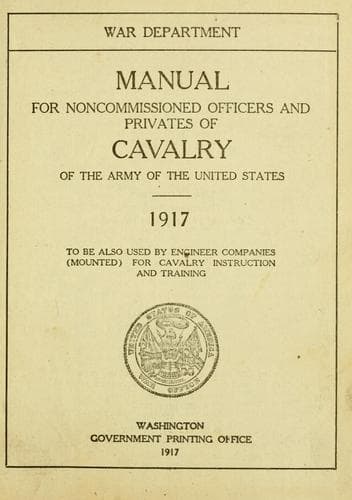
Manual for Noncommissioned Officers and Privates of Cavalry of the Army: of the United States 1917. To be also used by Engineer Companies (Mounted) for Cavalry Instruction and TrainingUnited States. War Department
History
Manual for Noncommissioned Officers and Privates of Cavalry of the Army: of the United States 1917. To be also used by Engineer Companies (Mounted) for Cavalry Instruction and Training
United States. War Department
United States. Army -- Handbooks, manuals, etc.
In case of abuse, he will promptly report to the troop commander.
Should the horse be the private property of an officer, he will report
such abuse to the owner.
=323.= The noncommissioned officer will report any unusual occurrence
during his tour direct to his troop commander.
=324.= Horses and other property for which the noncommissioned officer
is responsible will not be taken from the stables without the
authority of the post or troop commander.
=325.= The noncommissioned officer must answer the sentinel's calls
promptly.
=326.= In case of fire, the noncommissioned officer will see that the
requirements of paragraph 334 are promptly carried out.
=327.= Whenever it becomes necessary for the noncommissioned officer
to leave his guard, he will designate a member of it to take charge
and assume his responsibility during his absence.
SENTINELS OF THE TROOP STABLE GUARD.
=328.= The sentinel in the discharge of his duties will be governed by
the regulations for sentinels of the main guard whenever they are
applicable--such as courtesies to officers, walking post in a
soldierly manner, challenging, etc.; he will not turn out the guard
except when ordered by proper authority.
=329.= The sentinel will receive orders from the commanding officer,
the troop commander, and the noncommissioned officers of the stable
guard only, except when the commanding officer directs the officer of
the day to inspect the stable guard.
=330.= In the field and elsewhere when directed by the commanding
officer the sentinel when posted will verify the number of horses for
which he is responsible, and when relieved will give the number to
his successor.
=331.= The sentinel will not permit any horse or equipments to be
taken from the stables, except in the presence of the noncommissioned
officer.
=332.= Should a horse get loose, the sentinel will catch him and tie
him up. If he be unable to catch the horse, the noncommissioned
officer will at once be notified. In case a horse be cast, or in any
way entangled, he will relieve him, if possible; if unable to relieve
him, he will call the noncommissioned officer. Sentinels are forbidden
to punish or maltreat a horse.
=333.= When a horse is taken sick, the sentinel will notify the
noncommissioned officer, who in turn will call the farrier and see
that the horse is properly attended to.
=334.= In case of fire the sentinel will give the alarm by stepping
outside the stable and firing his pistol or piece repeatedly, and
calling out at the same time, "=Fire, stables, Troop (----).="
As soon as the guard is alarmed, he will take the necessary
precautions in opening or closing the doors so as to prevent the
spreading of the fire and make it possible to remove the horses; he
will drop the chains and bars, and, with the other members of the
guard, proceed to lead out the horses and secure them at the picket
line or such other place as may have been previously designated.
Public-domain text, read in full here on John Shaqi.
Reviews
Reviews
No reviews yet
Be the first to share your thoughts on this work.
Elsewhere in the archive
Join the Discussion
Join the discussion
Sign in to leave a comment or review.
Sign InorCreate an account