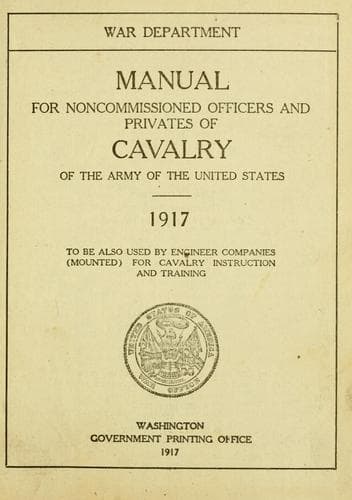
Manual for Noncommissioned Officers and Privates of Cavalry of the Army: of the United States 1917. To be also used by Engineer Companies (Mounted) for Cavalry Instruction and TrainingUnited States. War Department
History
Manual for Noncommissioned Officers and Privates of Cavalry of the Army: of the United States 1917. To be also used by Engineer Companies (Mounted) for Cavalry Instruction and Training
United States. War Department
United States. Army -- Handbooks, manuals, etc.
=343.= During the funeral of an enlisted man at a military post the
flag is displayed at halfstaff. It is hoisted to the top after the
final volley or gun is fired or after the remains are taken from the
post. The same honors are paid on the occasion of the funeral of a
retired enlisted man. (A. R. 423.)
=344.= When practicable, a detail consisting of a noncommissioned
officer and two privates of the guard will raise or lower the flag.
This detail wears side arms or if the special equipments do not
include side arms then belts only.
The noncommissioned officer, carrying the flag, forms the detail in
line, takes his post in the center and marches it to the staff. The
flag is then securely attached to the halyards and rapidly hoisted.
The halyards are then securely fastened to the cleat on the staff and
the detail marched to the guardhouse.
=345.= When the flag is to be lowered, the halyards are loosened from
the staff and made perfectly free. At retreat the flag is lowered at
the last note of retreat. It is then neatly folded and the halyards
made fast. The detail is then re-formed and marched to the guardhouse,
where the flag is turned over to the commander of the guard.
The flag should never be allowed to touch the ground and should always
be hoisted or lowered from the leeward side of the staff, the halyards
being held by two persons.
=Section 19. Reveille and Retreat Gun.=
=346.= The morning and evening gun will be fired by a detachment of
the guard, consisting, when practicable, of a corporal and two
privates. The morning gun is fired at the first note of reveille, or,
if marches be played before the reveille, it is fired at the beginning
of the first march. The retreat gun is fired at the last note of
retreat.
The corporal marches the detachment to and from the piece, which is
fired, sponged out, and secured under his direction.
=Section 20. Guard Mounting.=
=347.= Guard mounting will be formal or informal as the commanding
officer may direct. It will be held as prescribed in the drill
regulations of the arm of the service to which the guard belongs. If
none is prescribed, then as for infantry. In case the guard is
composed wholly of mounted organizations, guard mounting may be held
mounted.
=348.= When Infantry and mounted troops dismounted are united for
guard mounting, all details form as prescribed for Infantry.
FORMAL GUARD MOUNTING--MOUNTED.
(Extract Cavalry Drill Regulations, 1916.)
Public-domain text, read in full here on John Shaqi.
Reviews
Reviews
No reviews yet
Be the first to share your thoughts on this work.
Elsewhere in the archive
Join the Discussion
Join the discussion
Sign in to leave a comment or review.
Sign InorCreate an account