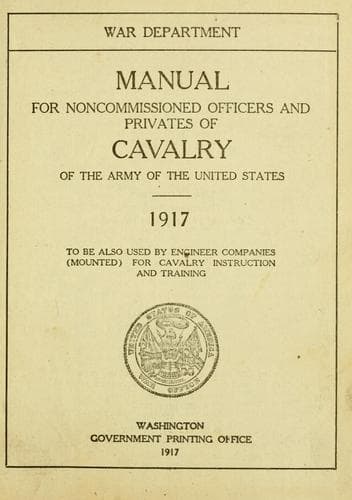
Manual for Noncommissioned Officers and Privates of Cavalry of the Army: of the United States 1917. To be also used by Engineer Companies (Mounted) for Cavalry Instruction and TrainingUnited States. War Department
History
Manual for Noncommissioned Officers and Privates of Cavalry of the Army: of the United States 1917. To be also used by Engineer Companies (Mounted) for Cavalry Instruction and Training
United States. War Department
United States. Army -- Handbooks, manuals, etc.
=335.= Sentinels over horses, or in charge of prisoners, receive
orders from the stable sergeant, so far as the care of the horses and
the labor of prisoners are concerned.
=336.= In field artillery and machine-gun organizations, the guard for
the stables has charge of the guns, caissons, etc., with their
ammunition and stores, as well as the horses, harness, and forage.
=Section 18. Flags.=
=337.= The garrison, post, and storm flags are national flags and
shall be of bunting. The union of each is as described in paragraph
216, Army Regulations, and shall be of the following proportions:
Width, seven-thirteenths of the hoist of the flag; length, seventy-six
one-hundredths of the hoist of the flag.
The garrison flag will have 38 feet fly and 20 feet hoist. It will be
furnished only to posts designated in orders from time to time from
the War Department, and will be hoisted only on holidays and important
occasions.
The post flag will have 19 feet fly and 10 feet hoist. It will be
furnished for all garrison posts and will be hoisted in pleasant
weather.
The storm flag will have 9 feet 6 inches fly and 5 feet hoist. It will
be furnished for all occupied posts for use in stormy and windy
weather. It will also be furnished to national cemeteries. (A. R.
223.)
=338.= At every military post or station the flag will be hoisted at
the sounding of the first note of the reveille, or of the first note
of the march, if a march be played before the reveille. The flag will
be lowered at the sounding of the last note of the retreat, while the
flag is being lowered the band will play "The Star-Spangled Banner,"
or, if there be no band present, the field music will sound "to the
color." When "to the color" is sounded by the field music while the
flag is being lowered the same respect will be observed as when "The
Star-Spangled Banner" is played by the band, and in either case
officers and enlisted men out of ranks will face toward the flag,
stand at attention, and render the prescribed salute at the last note
of the music. (A. R. 437.)
The lowering of the flag will be so regulated as to be completed at
the last note of "The Star-Spangled Banner" or "to the color."
=339.= The national flag will be displayed at a seacoast or lake fort
at the beginning of and during an action in which a fort may be
engaged, whether by day or by night. (A. R. 437.)
=340.= The national flag will always be displayed at the time of
firing a salute. (A. R. 397.)
=341.= The flag of a military post will not be dipped by way of salute
or compliment. (A. R. 405.)
=342.= On the death of an officer at a military post the flag is
displayed at halfstaff and so remains between reveille and retreat
until the last salvo or volley is fired over the grave; or if the
remains are not interred at the post until they are removed therefrom.
(A. R. 422.)
Public-domain text, read in full here on John Shaqi.
Reviews
Reviews
No reviews yet
Be the first to share your thoughts on this work.
Elsewhere in the archive
Join the Discussion
Join the discussion
Sign in to leave a comment or review.
Sign InorCreate an account