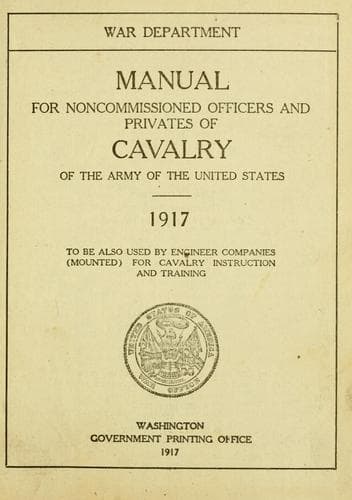
Manual for Noncommissioned Officers and Privates of Cavalry of the Army: of the United States 1917. To be also used by Engineer Companies (Mounted) for Cavalry Instruction and TrainingUnited States. War Department
History
Manual for Noncommissioned Officers and Privates of Cavalry of the Army: of the United States 1917. To be also used by Engineer Companies (Mounted) for Cavalry Instruction and Training
United States. War Department
United States. Army -- Handbooks, manuals, etc.
=859.= When the last detail has formed the sergeant major draws saber,
verifies the details, causes the guard to count fours, and, if there
be more than five fours, divides the guard into two or more platoons;
he designates the center guide or guides and then commands, =DRESS=
(Par. 362), verifies the alignment of rank and the line of
noncommissioned officers, and then returns to the right of the rank,
turns to the left, commands, =FRONT=, passes to a point midway between
the adjutant and center of the guard, halts facing the adjutant,
salutes, and reports: _Sir, the details are correct_; or, _Sir, (so
many) sergeants, corporals, or privates are absent_; the adjutant
returns the salute, directs the sergeant major: _Take your post_, and
then draws saber; the sergeant major turns to the left about and takes
post 3 yards to the left of and on a line with the rank. When the
sergeant major has completed his report the officer of the guard takes
post facing to the front 8 yards in front of the center of the guard
and draws saber. The adjutant then directs, _Inspect your guard, Sir_,
at which the commander of the guard turns about, commands: 1. =Draw=,
2. =SABER=, 3. =Prepare for inspection=, 4. =MARCH=, moves toward and
inspects the guard, as in troop inspection. During the inspection the
band plays.
The adjutant returns saber, observes the general condition of the
guard, and falls out any man who is unfit for guard duty or does not
present a creditable appearance. Substitutes will report to the
commander of the guard at the guard house.
The adjutant, when so directed, selects orderlies and color sentinels
as prescribed in the Manual of Interior Guard Duty and notifies the
commander of the guard of his selection. He may require a trooper to
move out of the rank and to dismount for a more minute inspection. He
also notifies the two senior noncommissioned officers to act as
platoon leaders if there has been a division into platoons. If there
be a junior officer of the guard, he takes post at the same time as
the senior, facing to the front 3 yards in front of the guide of the
first platoon, and the senior of the two noncommissioned officers acts
and takes post as chief of the second platoon. The junior officer of
the guard may be directed by the commander of the guard to assist in
inspecting the guard.
=860.= If there be no officer of the guard the adjutant inspects the
guard and during the inspection notifies the senior noncommissioned
officer to command the guard and the next two senior noncommissioned
officers to serve as platoon leaders. A noncommissioned officer
commanding the guard takes the post of the officer of the guard, the
next senior noncommissioned officer the post of the junior officer of
the guard.
Public-domain text, read in full here on John Shaqi.
Reviews
Reviews
No reviews yet
Be the first to share your thoughts on this work.
Elsewhere in the archive
Join the Discussion
Join the discussion
Sign in to leave a comment or review.
Sign InorCreate an account