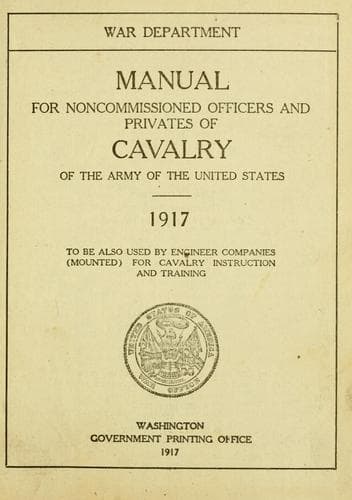
Manual for Noncommissioned Officers and Privates of Cavalry of the Army: of the United States 1917. To be also used by Engineer Companies (Mounted) for Cavalry Instruction and TrainingUnited States. War Department
History
Manual for Noncommissioned Officers and Privates of Cavalry of the Army: of the United States 1917. To be also used by Engineer Companies (Mounted) for Cavalry Instruction and Training
United States. War Department
United States. Army -- Handbooks, manuals, etc.
The inspection ended, the adjutant places himself about 30 yards in
front of and facing the center of the guard and draws saber. The new
officer of the day takes post in front of and facing the guard about
30 yards from the adjutant. The old officer of the day takes post 3
yards to the right of and 1 yard less advanced than the new officer of
the day. The commander of the guard takes post 8 yards in front of the
right trooper, facing to the front, and draws saber.
The adjutant then commands: 1. =Draw=, 2. =SABER=, 3. =SOUND OFF.=
The band, playing, passes in front of the commander of the guard to
the left of the line and back to its post on the right, when it ceases
playing.
The adjutant then commands =POSTS=, at which platoon leaders take
their posts 3 yards in front of the guides of their platoons, facing
to the front, and the commander of the guard takes post 6 yards in
front of the leader of the center (right) platoon, facing to the
front, and the file closers resume their places 3 yards in rear of the
rank. If there be no junior officer of the guard, the commander of the
guard takes post 3 yards in front of the center guide.
The commander of the guard and the chiefs of platoon and file closers
having taken their posts, the adjutant commands: 1. =Present=, 2.
=SABER=, faces toward the officer of the day, salutes, and then
reports, _Sir, the guard is formed_.
The new officer of the day, after the adjutant has reported, salutes
with the hand and directs the adjutant, _March the guard in review,
Sir._
=861.= The adjutant turns about, brings the guard to a carry, and
commands: 1. =Platoons right turn=, 2. =MARCH=; 3. =Guard=, 4. =HALT.=
The platoons execute the movement as in the troop, the band takes post
in front of the column (Par 806). The adjutant places himself abreast
of the first platoon and 6 yards from its left flank; the sergeant
major abreast of the second platoon and 6 yards from its left flank.
The adjutant then commands: 1. =Pass in review=, 2. =FORWARD=, 3.
=MARCH.=
The guard marches at the walk past the officer of the day, according
to the principles of squadron review, the adjutant, commander of the
guard, chiefs of platoon, sergeant major, and drum major saluting. The
new officer of the day returns the salute of the commander of the
guard and the adjutant only, making one salute with the hand.
=862.= The band, having passed the officer of the day, turns to the
left out of the column, places itself opposite to and facing him, and
continues to play until the guard leaves the parade ground. The
buglers detach themselves from the band when the latter turns out of
the column and remain in front of the guard, commencing to play when
the band ceases. In the absence of the band the buglers do not turn
out of the column, but continue to play in front of the guard.
Public-domain text, read in full here on John Shaqi.
Reviews
Reviews
No reviews yet
Be the first to share your thoughts on this work.
Elsewhere in the archive
Join the Discussion
Join the discussion
Sign in to leave a comment or review.
Sign InorCreate an account