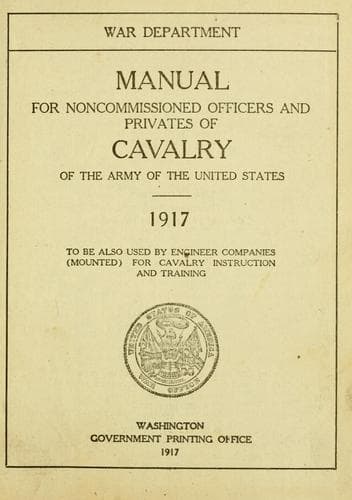
Manual for Noncommissioned Officers and Privates of Cavalry of the Army: of the United States 1917. To be also used by Engineer Companies (Mounted) for Cavalry Instruction and TrainingUnited States. War Department
History
Manual for Noncommissioned Officers and Privates of Cavalry of the Army: of the United States 1917. To be also used by Engineer Companies (Mounted) for Cavalry Instruction and Training
United States. War Department
United States. Army -- Handbooks, manuals, etc.
=870.= After the salutes have been acknowledged by the officers of the
day, each guard returns saber by command of its own officer of the
guard; the commander of the new guard then directs the orderly or
orderlies to fall out and report.
=871.= The commander of the new guard then falls out members of the
guard for detached posts, placing them under charge of the proper
noncommissioned officer, divides the guard into three reliefs,
_first_, _second_, and _third_, from right to left, and directs a list
of the guard to be made by reliefs. The sentinels and detachments of
the old guard are at once relieved by members of the new guard, the
two guards standing at ease or dismounted while these changes are
being made. The commander of the old transmits to the commander of the
new guard all his orders, instructions, and information concerning the
guard and its duties.
=872.= The commander of the new guard then has his own guard fall out,
takes possession of the guardhouse and verifies the articles in charge
of the guard.
=873.= If considerable time is required to bring in that portion of
the old guard still on post, the commanding officer may direct that as
soon as the orders and property are turned over to the new guard the
portion of the old guard at the guardhouse may be marched off and
dismissed. In such case the remaining detachments of the old guard
will be inspected by the commander of the new guard when they reach
the guardhouse. He will direct the senior noncommissioned officer
present to march these detachments off and dismiss them in the
prescribed manner.
=874.= In bad weather, at night, or after long marches the music may
be omitted, or the buglers may take the place of the band and sound
off standing on the right of the guard and the march in review be
omitted.
In cases in which an organization, entire or in part, is detailed for
guard, it is marched to the parade ground as a single detail (Par.
858.)
=875.= For detailed instructions for guards and sentinels see Manual
of Interior Guard Duty.
FORMAL GUARD MOUNTING, DISMOUNTED.
=876.= Guard mounting, dismounted, and relieving the old guard are
conducted on the same principles as when mounted, with the following
modifications:
(_a_) The men designated for guard fall in, dismounted, on their troop
parade grounds; noncommissioned officers not commanding detail, 2
paces in rear of rank.
(_b_) The detail that is to be on the right is marched to the line so
that upon halting the breast of the man on the right shall be near to
and opposite the left arm of the sergeant major. At the command
=DRESS=, the detail dresses up to the line of the sergeant major and
its commander, the man on the right placing his breast against the
left arm of the sergeant major.
Public-domain text, read in full here on John Shaqi.
Reviews
Reviews
No reviews yet
Be the first to share your thoughts on this work.
Elsewhere in the archive
Join the Discussion
Join the discussion
Sign in to leave a comment or review.
Sign InorCreate an account