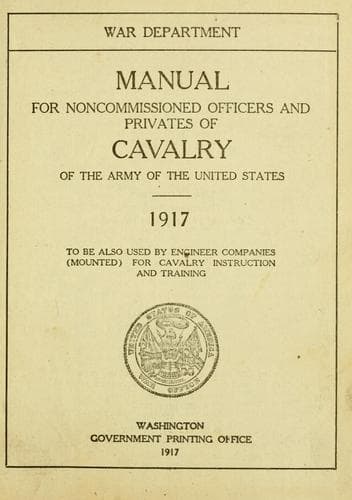
Manual for Noncommissioned Officers and Privates of Cavalry of the Army: of the United States 1917. To be also used by Engineer Companies (Mounted) for Cavalry Instruction and TrainingUnited States. War Department
History
Manual for Noncommissioned Officers and Privates of Cavalry of the Army: of the United States 1917. To be also used by Engineer Companies (Mounted) for Cavalry Instruction and Training
United States. War Department
United States. Army -- Handbooks, manuals, etc.
=863.= The guard having passed 12 yards beyond the officer of the day,
the adjutant halts; the sergeant major halts alongside of the adjutant
and 1 yard to his left; they then return saber, salute, and retire.
The commander of the guard then, without halting, breaks the guard
into column of fours and marches it to its post.
=864.= The officers of the day turn toward each other and salute, the
old officer of the day turning over the orders to the new officer of
the day.
While the band is sounding off and while the guard is passing in
review the officers of the day remain at attention.
=865.= If the guard be not divided into platoons the adjutant
commands: 1. =Guard right turn=, 2. =MARCH=; 3. =Guard=, 4: =HALT=,
and it passes in review as explained; the commander of the guard is 3
yards in front of its center guide, the adjutant is 6 yards from the
rank and abreast of the commander, the sergeant major covers the
adjutant and marches abreast of the rank.
RELIEVING THE OLD GUARD--(FORMAL GUARD MOUNTING, MOUNTED.)
=866.= As the new guard approaches the guardhouse the old guard is
formed in line at the carry saber, its buglers 3 yards to its right;
when the buglers at the head of the new guard arrive opposite the left
of the old guard its commander commands: 1. =Present=, 2. =SABER=;
both commanders salute and, when the new guard has passed the
commander of the old guard, the latter commands: 1. =Carry=, 2.
=SABER.= The buglers and guard continue marching without changing
direction until the rear of the column has passed 9 yards beyond the
buglers of the old guard, when the commander of the new guard
commands: 1. =Fours right=, 2. =MARCH.=
=867.= The buglers and guard are marched 3 yards in rear of the line
of the old guard, when the commander of the new guard commands: 1.
=Fours right about=, 2. =MARCH=; 3. =Guard=, 4. =HALT=; 5. =DRESS=; he
then, facing to the front, aligns his guard so as to be on a line with
the old guard and commands, =Front=; the buglers of the new guard are
3 yards to the right of the rank.
=868.= The new guard being dressed, the commander of each guard, in
front of and facing its center, commands: 1. =Present=, 2. =SABER=,
resumes his front, salutes, resumes the carry, faces his guard, and
commands: 1. =Carry=, 2. =SABER.=
Each guard is then presented by its commander to its officer of the
day; if there be but one officer of the day present, or if an officer
acts in the capacity of old and new officer of the day, each guard is
presented to him by its commander.
=869.= If another person entitled to a salute approaches, each
commander of the guard brings his own guard to attention if not
already at attention. The senior commander of the two guards then
commands: 1. =Old and new guards=, 2. =Present=, 3. =SABER.= The
junior will salute at the command "Present, Saber," given by the
senior. After the salute has been acknowledged the senior brings both
guards to the "Carry, Saber."
Public-domain text, read in full here on John Shaqi.
Reviews
Reviews
No reviews yet
Be the first to share your thoughts on this work.
Elsewhere in the archive
Join the Discussion
Join the discussion
Sign in to leave a comment or review.
Sign InorCreate an account