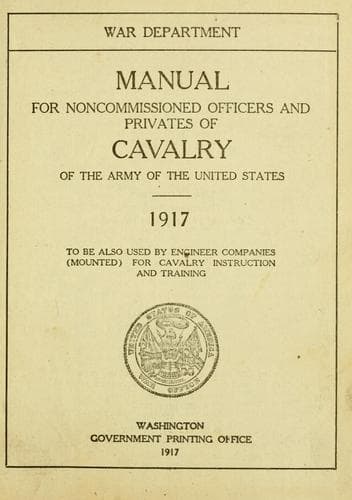
Manual for Noncommissioned Officers and Privates of Cavalry of the Army: of the United States 1917. To be also used by Engineer Companies (Mounted) for Cavalry Instruction and TrainingUnited States. War Department
History
Manual for Noncommissioned Officers and Privates of Cavalry of the Army: of the United States 1917. To be also used by Engineer Companies (Mounted) for Cavalry Instruction and Training
United States. War Department
United States. Army -- Handbooks, manuals, etc.
The field music having marched three paces beyond the field music of
the old guard, changes direction to the right, and, followed by the
guard, changes direction to the left when on a line with the old
guard; the changes of direction are without command. The commander of
the guard halts on the line of the front rank of the old guard, allows
his guard to march past him, and, when its rear approaches, forms it
in line to the left, establishes the left guide three paces to the
right of the field music of the old guard, and on a line with the
front rank, and then dresses his guard to the left; the field music of
the new guard is three paces to the right of its front rank.
=361.= The new guard being dressed the commander of each guard, in
front of and facing its center, commands: 1. =Present=, 2. =ARMS=,
resumes his front, salutes, carries saber, faces his guard, and
commands: 1. =Order=, 2. =ARMS=.
Should a guard be commanded by a noncommissioned officer, he stands on
the right or left of the front rank, according as he commands the old
or new guard, and executes the rifle salute.
=362.= After the new guard arrives at its post and has saluted the old
guard, each guard is presented by its commander to its officer of the
day; if there be but one officer of the day present, or if one officer
acts in the capacity of old and new officer of the day, each guard is
presented to him by its commander.
=363.= If other persons entitled to a salute approach, each commander
of the guard will bring his own guard to attention if not already at
attention. The senior commander of the two guards will then command:
"1. =Old and new guards=, 2. =Present=, 3. =Arms=."
The junior will salute at the command "=Present Arms=" given by the
senior. After the salute has been acknowledged, the senior brings both
guards to the order.
=364.= After the salutes have been acknowledged by the officers of the
day, each guard is brought to an order by its commander; the commander
of the new guard then directs the orderly or orderlies to fall out and
report and causes bayonets to be fixed if so ordered by the commanding
officer; bayonets will not then be unfixed during the tour except in
route marches while the guard is actually marching or when specially
directed by the commanding officer.
The commander of the new guard then falls out members of the guard for
detached posts, placing them under charge of the proper
noncommissioned officers, divides the guard into three reliefs,
=first=, =second=, and =third=, from right, to left, and directs a
list of the guard to be made by reliefs. When the guard consists of
troops of different arms combined, the men are assigned to reliefs so
as to insure a fair division of duty under rules prescribed by the
commanding officer.
Public-domain text, read in full here on John Shaqi.
Reviews
Reviews
No reviews yet
Be the first to share your thoughts on this work.
Elsewhere in the archive
Join the Discussion
Join the discussion
Sign in to leave a comment or review.
Sign InorCreate an account