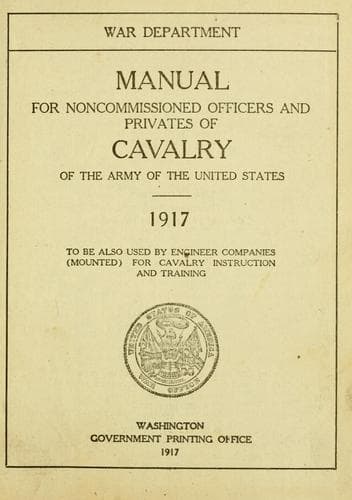
Manual for Noncommissioned Officers and Privates of Cavalry of the Army: of the United States 1917. To be also used by Engineer Companies (Mounted) for Cavalry Instruction and TrainingUnited States. War Department
History
Manual for Noncommissioned Officers and Privates of Cavalry of the Army: of the United States 1917. To be also used by Engineer Companies (Mounted) for Cavalry Instruction and Training
United States. War Department
United States. Army -- Handbooks, manuals, etc.
NOTE.--To call a station, make the call letter until acknowledged, at
intervals giving the call or signal of the calling station. If the
call letter of a station is unknown, wave flag until acknowledged. In
using the searchlight without shutter throw the beam in a vertical
position and move it through an arc of 180° in a plane at right angles
to the line connecting the two stations until acknowledged. To
acknowledge a call, signal "Acknowledgment" followed by the call
letter of the acknowledging station.
=Signaling with Heliograph, Flash lantern, and Searchlight (With
Shutter.)=
GENERAL SERVICE CODE.
=26.= The first position is to turn a steady flash on the receiving
station. The signals are made by short and long flashes. Use a short
flash for dot and a long steady flash for dash. The elements of a
letter should be slightly longer than in sound signals.
=27.= To call a station, make its call letter until acknowledged.
=28.= If the call letter of a station be unknown, signal A until
acknowledged. Each station will then turn on a steady flash and
adjust. When adjustment is satisfactory to the called station, it will
cut off its flash and the calling station will proceed with its
message.
=29.= If the receiver sees that the sender's mirror or light needs
adjustment, he will turn on a steady flash until answered by a steady
flash. When the adjustment is satisfactory the receiver will cut off
his flash and the sender will resume his message.
=30.= To break the sending station for other purposes, turn on a
steady flash.
SOUND SIGNALS.
=56.= Sound signals made by the whistle, foghorn, bugle, trumpet, and
drum may well be used in a fog, mist, falling snow, or at night. They
may be used with the dot and dash code.
In applying the General Service Code to whistle, foghorn, bugle, or
trumpet, one short blast indicates a dot and one long blast a dash.
With the drum, one tap indicates a dot and two taps in rapid
succession a dash. Although these signals can be used with a dot and
dash code, they should be so used in connection with a preconcerted or
conventional code.
=Signaling by Two-Arm Semaphore.=
HAND FLAGS.
=43.= Signaling by the two-arm semaphore is the most rapid method of
sending spelled-out messages. It is, however, very liable to error if
the motions are slurred over or run together in an attempt to make
speed. Both arms should move rapidly and simultaneously, but there
should be a perceptible pause at the end of each letter before making
the movements for the next letter. Rapidity is secondary to accuracy.
For alphabet see pages following.
[Illustration: Hand-signal.]
[Illustration: Hand-signal.]
Public-domain text, read in full here on John Shaqi.
Reviews
Reviews
No reviews yet
Be the first to share your thoughts on this work.
Elsewhere in the archive
Join the Discussion
Join the discussion
Sign in to leave a comment or review.
Sign InorCreate an account