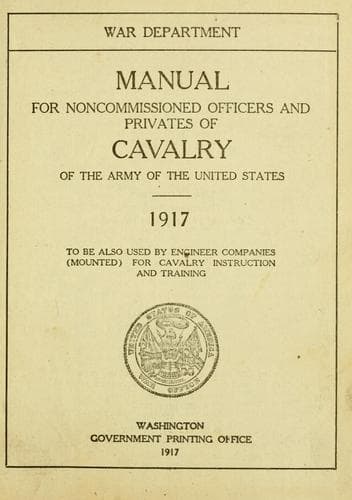
Manual for Noncommissioned Officers and Privates of Cavalry of the Army: of the United States 1917. To be also used by Engineer Companies (Mounted) for Cavalry Instruction and TrainingUnited States. War Department
History
Manual for Noncommissioned Officers and Privates of Cavalry of the Army: of the United States 1917. To be also used by Engineer Companies (Mounted) for Cavalry Instruction and Training
United States. War Department
United States. Army -- Handbooks, manuals, etc.
End of word. Interval.
End of sentence. Double interval.
End of message. Triple interval.
Signal separating preamble
from address; address
from text;
text from signature. -- . . . -- Double interval,
signature preceded
also by "Sig" interval.
Acknowledgement. R.
Error. . . . . . . . . A.
Negative. K.
Preparatory. L.
Annulling. N.
Affirmative. P.
Interrogatory. . . -- -- . . O.
Repeat after word. Interrogatory. A (word).
Repeat last message. Interrogatory three times.
Send faster. QRQ
Send slower. QRS
Cease sending. QRT
Wait a moment. . -- . . . None.
Execute. IX, IX
Move to your right. MR
Move to your left. ML
Move up. MU
Move down. MD
Finished (end of work). . . . -- . -- None.
=Visual Signaling: By Flag (Wig-Wag), Torch, Hand Lantern, or Beam or
Searchlight (Without Shutter).=
GENERAL SERVICE CODE.
=23.= For the flag used with the General Service Code there are three
motions and one position. The position is with the flag held
vertically, the signalman facing directly toward the station with
which it is desired to communicate. The first motion (the dot) is to
the right of the sender, and will embrace an arc of 90°, starting with
the vertical and returning to it, and will be made in a plane at
right-angles to the line connecting the two stations. The second
motion (the dash) is a similar motion to the left of the sender. The
third motion (front) is downward directly in front of the sender and
instantly returned upward to the first position. Front is used to
indicate an interval.
=24.= The beam of the searchlight, though ordinarily used with the
shutter like the heliograph, may be used for long-distance signaling,
when no shutter is suitable or available, in a similar manner to the
flag or torch, the first position being a vertical one. A movement of
the beam 90° to the right of the sender indicates a dot, a similar
movement to the left indicates a dash; the beam is lowered vertically
for front.
=25.= To use the torch or hand lantern, a footlight must be employed
as a point of reference to the motion. The lantern is most
conveniently swung out upward to the right of the footlight for a dot,
to the left for a dash, and raised vertically for front.
Public-domain text, read in full here on John Shaqi.
Reviews
Reviews
No reviews yet
Be the first to share your thoughts on this work.
Elsewhere in the archive
Join the Discussion
Join the discussion
Sign in to leave a comment or review.
Sign InorCreate an account