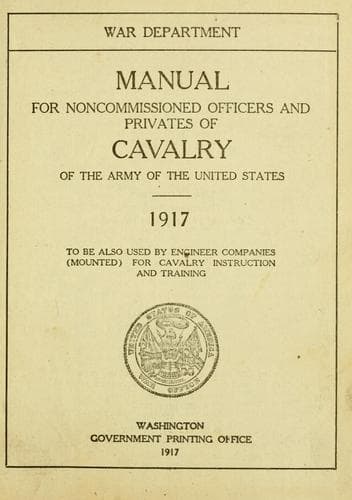
Manual for Noncommissioned Officers and Privates of Cavalry of the Army: of the United States 1917. To be also used by Engineer Companies (Mounted) for Cavalry Instruction and TrainingUnited States. War Department
History
Manual for Noncommissioned Officers and Privates of Cavalry of the Army: of the United States 1917. To be also used by Engineer Companies (Mounted) for Cavalry Instruction and Training
United States. War Department
United States. Army -- Handbooks, manuals, etc.
O--What is the (R. N., etc.)? Interrogatory. (Ardois and
semaphore only.)
. . -- -- . . -- What is the (R. N., etc.)? Interrogatory. (All
methods but Ardois and semaphore.)
P--Affirmative. Yes.
PS--Percussion. Shrapnel.
QRQ--Send faster.
QRS--Send slower.
QRT--Cease sending.
R--Acknowledgment. Received.
RS--Regimental station.
RL--Right from the left.
RR--Right from the right.
RN--Range.
RT--Right.
S--Subtract.
SCL (numerals)--On 2d piece close by (so much).
SOP (numerals)--On 2d piece open by (so much).
SH--Shell.
SI--Site.
SSS--Support needed.
T--Target.
TCL (numericals)--On 3d piece close by (so much).
TOP (numerals)--On 3d piece open by (so much).
U--Up.
Y (letter)--Such battery station.
CHAPTER XIII.
FIRST-AID RULES.
The bandages and dressings contained in the first-aid packet have been
so treated as to destroy any germs thereon. Therefore, when dressing a
wound, be careful not to touch or handle that part of the dressing
which is to be applied to the wound.
A sick or injured person should always be made to lie down on his
back, if practicable, as this is the most comfortable position, and
all muscles may be relaxed.
All tight articles of clothing and equipment should be loosened, so as
not to interfere with breathing or the circulation of the blood.
Belts, collars, and the trousers at the waist should be opened.
Don't let mere onlookers crowd about the patient. They prevent him
from getting fresh air and also make him nervous and excited.
In case of injury the heart action is generally weak from shock, and
the body, therefore, grows somewhat cold. So don't remove any more
clothing than is necessary to expose the injury.
Cut or rip the clothing, but don't pull it. Try to disturb the patient
as little as possible.
Don't touch a wound with your fingers or a handkerchief, or with
anything else but the first-aid dressing. Don't wash the wound with
water, as you may infect it.
Don't administer stimulants (whisky, brandy, wine, etc.) unless
ordered to do so by a doctor. While in a few cases stimulants are of
benefit, in a great many cases they do positive harm, especially where
there has been any bleeding.
The heart may be considered as a pump and the arteries as a rubber
hose, which carry the blood from the heart to every part of the body.
The veins are the hose which carry the blood back to the heart. Every
wound bleeds some, but, unless a large artery or a large vein is cut,
the bleeding will stop after a short while if the patient is kept
quiet and the first-aid dressing is bound over the wound so as to make
pressure on it.
Public-domain text, read in full here on John Shaqi.
Reviews
Reviews
No reviews yet
Be the first to share your thoughts on this work.
Elsewhere in the archive
Join the Discussion
Join the discussion
Sign in to leave a comment or review.
Sign InorCreate an account