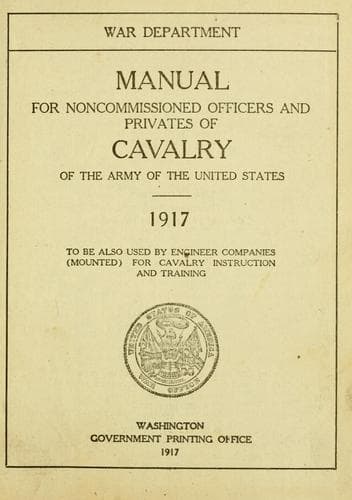
Manual for Noncommissioned Officers and Privates of Cavalry of the Army: of the United States 1917. To be also used by Engineer Companies (Mounted) for Cavalry Instruction and TrainingUnited States. War Department
History
Manual for Noncommissioned Officers and Privates of Cavalry of the Army: of the United States 1917. To be also used by Engineer Companies (Mounted) for Cavalry Instruction and Training
United States. War Department
United States. Army -- Handbooks, manuals, etc.
When a large artery is cut the blood gushes out in spurts every time
the heart beats. In this case it is necessary to stop the flow of
blood by pressing upon the hose somewhere between the heart and the
leak.
If the leak is in the arm or hand, apply pressure as in figure 1.
[Illustration: FIG. 1.]
If the leak is in the leg, apply pressure as in figure 2.
[Illustration: FIG. 2.]
If the leak is in the shoulder or armpit, apply pressure as in figure
3.
[Illustration: FIG. 3.]
The reason for this is that at the places indicated the arteries may
be pressed against a bone more easily than at any other places.
Another way of applying pressure (by means of a tourniquet) is shown
in figure 4. Place a pad of tightly rolled cloth or paper, or any
suitable object, over the artery. Tie a bandage loosely about the
limb and then insert your bayonet, or a stick, and twist up the
bandage until the pressure of the pad on the artery stops the leak.
Twist the bandage slowly and stop as soon as the blood ceases to flow,
in order not to bruise the flesh or muscles unnecessarily.
[Illustration: FIG. 4.--Improvised tourniquet.]
A tourniquet may cause pain and swelling of the limb, and if left on
too long may cause the limb to die. Therefore, about every half hour
or so loosen the bandage very carefully, but if the bleeding continues
pressure must be applied again. In this case apply the pressure with
the thumb for five or ten minutes, as this cuts off only the main
artery and leaves some of the smaller arteries and the veins free to
restore some of the circulation. When a tourniquet is painful it is
too tight and should be carefully loosened a little.
If the leg or arm is held upright, this also helps to reduce the
bleeding in these parts, because the heart then has to pump the blood
uphill.
A broken bone is called a fracture. The great danger in the case of a
fracture is that the sharp, jagged edges of the bones may stick
through the flesh and skin, or tear and bruise the arteries, veins,
and muscles. If the skin is not broken, a fracture is not so serious,
as no germs can get in. =Therefore never move a person with a broken
bone until the fracture has been so fixed that the broken ends of the
bone can not move.=
If the leg or arm is broken, straighten the limb gently and if
necessary pull upon the end firmly to get the bones in place. Then
bind the limb firmly to a splint to hold it in place. A splint may be
made of any straight, stiff material--a shingle or piece of board, a
bayonet, a rifle, a straight branch of a tree, etc. Whatever material
you use must be well padded on the side next to the limb. Be careful
never to place the bandages over the fracture, but always above and
below. (Figs. 5, 6, 7, 8.)
[Illustration: FIG. 5.]
[Illustration: FIG. 6.]
[Illustration: FIG. 7.]
[Illustration: FIG. 8.]
Public-domain text, read in full here on John Shaqi.
Reviews
Reviews
No reviews yet
Be the first to share your thoughts on this work.
Elsewhere in the archive
Join the Discussion
Join the discussion
Sign in to leave a comment or review.
Sign InorCreate an account