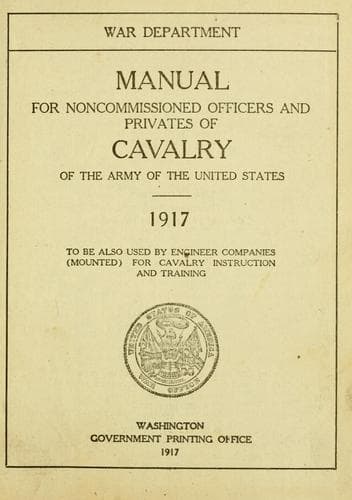
Manual for Noncommissioned Officers and Privates of Cavalry of the Army: of the United States 1917. To be also used by Engineer Companies (Mounted) for Cavalry Instruction and TrainingUnited States. War Department
History
Manual for Noncommissioned Officers and Privates of Cavalry of the Army: of the United States 1917. To be also used by Engineer Companies (Mounted) for Cavalry Instruction and Training
United States. War Department
United States. Army -- Handbooks, manuals, etc.
The following list includes the offenses most often committed by
soldiers, generally through ignorance or carelessness rather than
viciousness. Violations of any rule or regulation should be carefully
guarded against, since they not only subject the offender to
punishment, but also bring discredit on his comrades, his
organization, and on the military profession:
1. Selling, pawning, or, through neglect, losing or spoiling any
Government property, such as uniforms, blankets, equipment,
ammunition, etc.
2. Disobedience of the orders of any officer or noncommissioned
officer.
3. Disrespect to an officer or noncommissioned officer.
4. Absence from camp without leave.
5. Absence from any drill, formation, or other duty without authority.
6. Drunkenness on duty or off duty, whether in camp or when absent
either with or without leave.
7. Bringing liquor into camp.
8. Noisy or disorderly conduct in camp or when absent either with or
without leave.
9. Entering on private property, generally for the purpose of
stealing fruit, etc.
10. Negligence or carelessness at drill or on other duty, particularly
while on guard or as a sentinel over prisoners.
11. Wearing an unauthorized uniform or wearing the uniform in an
improper manner.
12. Urinating in or around camp.
13. Failing to salute properly.
14. Disrespect or affront to a sentinel.
15. Abuse or neglect of his horse.
"The basic principles of the combat tactics of the different arms are
set forth in the Drill Regulations of those arms for units as high as
brigades." (_Preface, Field Service Regulations._)
"The Drill Regulations are furnished as a guide. They provide the
principles for training and for increasing the probability of success
in battle. In the interpretation of the regulations the spirit must be
sought. Quibbling over the minutiæ of form is indicative of failure to
grasp the spirit." (_Paragraph 4, Infantry Drill Regulations._)
Field Service Regulations govern all arms of the Army of the United
States.
=Section 2. The Army of the United States.=
The Army of the United States shall consist of the Regular Army, the
Volunteer Army, the Officers' Reserve Corps, the Enlisted Reserve
Corps, the National Guard while in the service of the United States,
and such other land forces as are now or may hereafter be authorized
by law. (Sec. 1, act of June 3, 1916.)
=Section 3. Rank and precedence of officers and noncommissioned
officers.=
The following are the grades of rank of officers and noncommissioned
officers:
1. Lieutenant general.
2. Major general.
3. Brigadier general.
4. Colonel.
5. Lieutenant colonel.
6. Major.
7. Captain.
8. First Lieutenant.
9. Second lieutenant.
10. Aviator, Signal Corps.
11. Cadet.
Public-domain text, read in full here on John Shaqi.
Reviews
Reviews
No reviews yet
Be the first to share your thoughts on this work.
Elsewhere in the archive
Join the Discussion
Join the discussion
Sign in to leave a comment or review.
Sign InorCreate an account