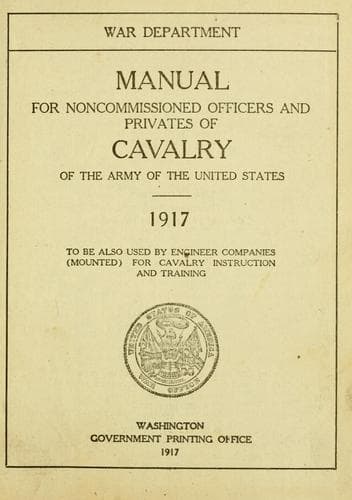
Manual for Noncommissioned Officers and Privates of Cavalry of the Army: of the United States 1917. To be also used by Engineer Companies (Mounted) for Cavalry Instruction and TrainingUnited States. War Department
History
Manual for Noncommissioned Officers and Privates of Cavalry of the Army: of the United States 1917. To be also used by Engineer Companies (Mounted) for Cavalry Instruction and Training
United States. War Department
United States. Army -- Handbooks, manuals, etc.
The operator's arms are held straight, and his weight is brought from
his shoulders by bringing his body and shoulders forward. This weight
is gradually increased until at the end of the three seconds of
vertical pressure upon the lower ribs of the patient the force is felt
to be heavy enough to compress the parts; then the weight is suddenly
removed. If there is danger of not returning the hands to the right
position again, they can remain lightly in place; but it is usually
better to remove the hands entirely. If the operator is light and the
patient an overweight adult, he can utilize over 80 per cent of his
weight by raising his knees from the ground and supporting himself
entirely on his toes and the heels of his hands, the latter properly
placed on the ends of the floating ribs of the patient. In this manner
he can work as effectively as a heavy man.
A light feather or a piece of absorbent cotton drawn out thin and held
near the nose by some one will indicate by its movements whether or
not there is a current of air going and coming with each forced
expiration and spontaneous inspiration.
The natural rate of breathing is 12 to 15 times per minute. The rate
of operation should not exceed this. The lungs must be thoroughly
emptied by three seconds of pressure, then refilling takes care of
itself. Pressure and release of pressure--one complete
respiration--occupies about five seconds. If the operator is alone, he
can be guided in each act by his own deep, regular respiration or by
counting or by his watch lying by his side. If comrades are present,
he can be advised by them.
The duration of the efforts as artificial respiration should
ordinarily exceed an hour; indefinitely longer if there are any
evidences of returning animation, by way of breathing, speaking, or
movements. There are liable to be evidences of life within 25 minutes
in patients who will recover from electric shock, but where there is
doubt the patient should be given the benefit of the doubt. In
drowning, especially, recoveries are on record after two hours or more
of unconsciousness; hence, the Schaefer method, being easy of
operation, is more likely to be persisted in.
Aromatic spirits of ammonia may be poured on a handkerchief and held
continuously within 3 inches of the face and nose. If other ammonia
preparations are used, they should be diluted or held farther away.
Try it on your own nose first.
When the operator is a heavy man it is necessary to caution him not to
bring force too violently upon the ribs, as one of them might be
broken.
Do not attempt to give liquids of any kind to the patient while
unconscious. Apply warm blankets and hot-water bottles as soon as
they can be obtained.
CHAPTER XIV.
LAWS AND REGULATIONS.
=Section 1. General provisions.=
The Army of the United States is governed by certain laws called "The
Articles of War" and certain regulations called "Army Regulations."
Public-domain text, read in full here on John Shaqi.
Reviews
Reviews
No reviews yet
Be the first to share your thoughts on this work.
Elsewhere in the archive
Join the Discussion
Join the discussion
Sign in to leave a comment or review.
Sign InorCreate an account