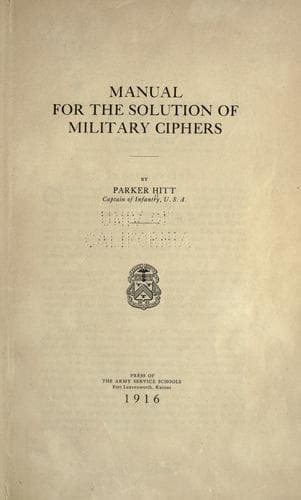
Manual for the Solution of Military Ciphers — John Shaqi
Manual for the Solution of Military CiphersHitt, Parker
History
Manual for the Solution of Military Ciphers
Hitt, Parker
Ciphers; Cryptography
It is unnecessary to point out that a cipher which can be deciphered
by the enemy in a few hours is worse than useless. It requires a
surprisingly long time to encipher and decipher a message, using even
the simplest kind of cipher, and errors in transmission of cipher
matter by wire or radio are unfortunately too common.
Kerckhoffs has stated that a military cipher should fulfill the
following requirements:
1st. The system should be materially, if not mathematically,
indecipherable.
2d. It should cause no inconvenience if the apparatus and methods
fall into the hands of the enemy.
3d. The key should be such that it could be communicated and
remembered without the necessity of written notes and should
be changeable at the will of the correspondents.
4th. The system should be applicable to telegraphic correspondence.
5th. The apparatus should be easily carried and a single person
should be able to operate it.
6th. Finally, in view of the circumstances under which it must
be used, the system should be an easy one to operate,
demanding neither mental strain nor knowledge of a long series
of rules.
A brief consideration of these six conditions must lead to the
conclusion that there is no perfect military cipher. The first
requirement is the one most often overlooked by those prescribing
the use of any given cipher and, even if not overlooked, the
indecipherability of any cipher likely to be used for military purposes
is usually vastly overestimated by those prescribing the use of it.
If this were not true, there would have been neither material for,
nor purpose in, the preparation of these notes. Of the hundreds of
actual cipher messages examined by the writer, at least nine-tenths
have been solved by the methods to be set forth. These messages were
prepared by the methods in use by the United States Army, the various
Mexican armies and their secret agents, and by other methods in common
use. The usual failure has been with very short messages. Foreign
works consulted lead to the belief that many European powers have
used, for military purposes, cipher methods which vary from an
extreme simplicity to a complexity which is more apparent than
real. What effect recent events have had on this matter remains to
be seen. It is enough that the cipher experts of practically every
European country have appealed to the military authorities of their
respective countries time and again to do away with these useless
ciphers and to adopt something which offers more security, even at
the expense of other considerations.
Public-domain text, read in full here on John Shaqi.
Reviews
Reviews
No reviews yet
Be the first to share your thoughts on this work.
Join the Discussion
Join the discussion
Sign in to leave a comment or review.
Sign InorCreate an account