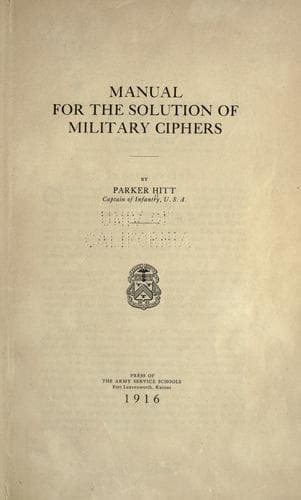
Manual for the Solution of Military Ciphers — John Shaqi
Manual for the Solution of Military CiphersHitt, Parker
History
Manual for the Solution of Military Ciphers
Hitt, Parker
Ciphers; Cryptography
Case 3. Route ciphers. In this case, whole words of the message
are transposed according to some of the methods of Case 1 or 2 or
their equivalents. The route cipher is little used at present. Its
development and use during the Civil War was caused by the inability
of the telegraphers of that day to handle regular cipher matter
correctly and rapidly. It was, even in those days, frankly only
a delaying cipher and, to be of any value, had to be filled with
meaningless words to conceal the message proper. An example from
the Signal Book will suffice to show the general character of route
ciphers. To one familiar with monoliteral transposition ciphers,
even the best of route ciphers offers but little difficulty.
"To encipher the message 'MOVE DAYLIGHT. ENEMY APPROACHING FROM
NORTH. PRISONERS SAY STRENGTH ONE HUNDRED THOUSAND. MEET HIM AS
PLANNED.' arrange as follows:
MOVE STRENGTH PLANNED SAY
DAYLIGHT ONE AS PRISONERS
ENEMY HUNDRED HIM NORTH
APPROACHING THOUSAND MEET FROM
Here the route is down the first column, up the fourth, down the
second and up the third."
This cipher was often complicated by the introduction of nulls for
every fifth word. Thus the above message might be sent:
MOVE STRENGTH PLANNED SAY NEVER DAYLIGHT ONE AS PRISONERS LEAVING
ENEMY HUNDRED HIM NORTH UNCHANGED APPROACHING THOUSAND MEET
FROM COME.
The words in italics are nulls and not a part of the message and the
receiver eliminates them before arranging his message in columns to
get the sense of it.
As an additional complication, it was customary for each correspondent
to have a dictionary or code in which the names of all prominent
generals and places and many of the prominent verbs,--as to march,
to sail, to encamp, to attack, to retreat,--were represented by
other words.
A route cipher using the code words of the War Department code might
have some advantages over the method of enciphering code messages as
prescribed in that Code.
General Remarks on Transposition Ciphers
It is the consensus of opinion of experts that the transposition
cipher is not the best one for military purposes. It does not
fulfill the first, second, and third of Kerckhoffs' requirements as
to indecipherability, safety when apparatus and method fall into the
hands of the enemy, and dependability on a readily changeable key word.
However, transposition ciphers are often encountered. They are
favorites with those who find the substitution ciphers too difficult
and too tedious to handle and who believe that their transposition
methods are either absolutely indecipherable or sufficiently so
for the purpose of concealing the text of a message for the time
being. They seem to be particularly popular with secret agents and
spies, presumably because special apparatus is rarely necessary in
enciphering and deciphering.
Public-domain text, read in full here on John Shaqi.
Reviews
Reviews
No reviews yet
Be the first to share your thoughts on this work.
Join the Discussion
Join the discussion
Sign in to leave a comment or review.
Sign InorCreate an account