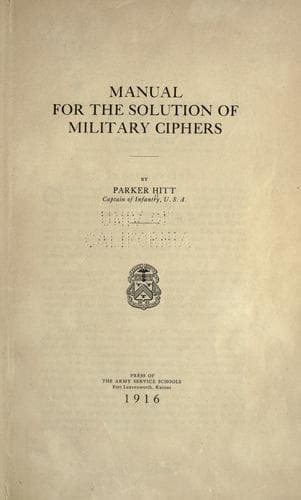
Manual for the Solution of Military Ciphers — John Shaqi
Manual for the Solution of Military CiphersHitt, Parker
History
Manual for the Solution of Military Ciphers
Hitt, Parker
Ciphers; Cryptography
The equipment for an office, where much cipher work is handled,
will now be considered. The casual worker with ciphers can get along
with much less, but the methods of filing and keeping a record of all
messages studied should be followed wherever possible. The interchange
of results between individuals and between offices should be encouraged
and, in time of active operations, should be mandatory. An enemy
may be using the same cipher in widely separated parts of the zone
of operations and it is useless labor to have many cipher offices
working on intercepted messages, all in the same cipher, when one
office may have the solution that will apply to all of them.
Cipher work requires concentration and quiet and often must proceed
without regard to hours. The office should be chosen with these points
in mind. A clerical force is desirable and even necessary if there
is much work to do. The clerk or clerks can soon be trained to do
the routine part of the analysis.
It is believed that each Field Army should have such an office
where all ciphers intercepted by forces under command of the Field
Army Commander should be sent at once for examination. This work
naturally falls to the Intelligence section of the General Staff at
this headquarters. A special radio station, with receiving instruments
only, should be an adjunct to this office and its function should
be to copy all hostile radio messages whether in cipher or plain
text. Such a radio station requires but a small antenna; one of the
pack set type or any amateur's antenna is sufficient, and the station
instruments can be easily carried in a suit case. Three thoroughly
competent operators should be provided, so that the station can be
"listening in" during the entire twenty-four hours.
The office should be provided with tables of frequency of the language
of the enemy, covering single letters and digraphs; a dictionary and
grammar of that language; copies of the War Department Code, Western
Union Code and any other available ones; types of apparatus or, at
least, data on apparatus and cipher methods in use by the enemy; and
a safe filing cabinet and card index for filing messages examined. A
typewriter is also desirable.
The office work on a cipher under examination should be done on paper
of a standard and uniform size. Printed forms containing twenty-six
ruled lines and a vertical alphabet are convenient and save time in
preparation of frequency tables. Any new cipher methods which are
found to be in use by the enemy should, when solved, be communicated
to all similar offices in the Army for their information.
Unless an enemy were exceedingly vigilant and changed keys and methods
frequently, such an office would, in a few days, be in a position
to disclose completely all intercepted cipher communications of the
enemy with practically no delay.
CHAPTER II
PRINCIPLES OF MECHANISM OF A WRITTEN LANGUAGE
Public-domain text, read in full here on John Shaqi.
Reviews
Reviews
No reviews yet
Be the first to share your thoughts on this work.
Join the Discussion
Join the discussion
Sign in to leave a comment or review.
Sign InorCreate an account