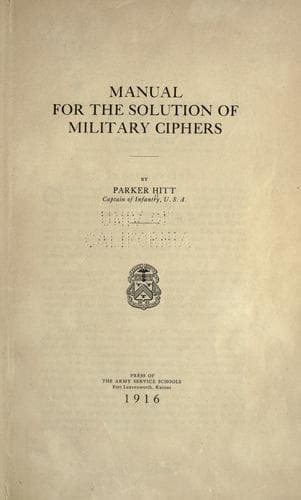
Manual for the Solution of Military CiphersHitt, Parker
History
Manual for the Solution of Military Ciphers
Hitt, Parker
Ciphers; Cryptography
The first line of the message of Case 2-b is:
SLCOF WEETN EBRDO ORVYM FFEDI
We might write it TMDPG XFFUO FCSEP PSWZN GGFEJ, or RKBNE VDDSM DAQCN
NQUXL EEDCH (Case 4-a, going forward one letter or back one letter).
These examples give an idea of the use of combination methods. It is
very rare to find both complicated transposition and substitution
methods used in combination. If one is complicated, the other will
usually be very simple; and ordinarily both are simple, the sender
depending on the combination of the two to attain indecipherability. It
is evident how futile this idea is.
Methods of Enciphering Numerals
It is frequently desirable to send numerals in the body of a cipher
message. Several cipher systems prescribe that all numerals in the
body of a message must be spelled out; and, while there is no doubt
but that this insures greater accuracy, it also greatly increases the
length of such messages. In most systems in which it is permissible
to send numerals, the following system is used. An indicator, one of
the little used letters and especially X, is interpolated before and
after the numeral or numerals to be enciphered, and then, for each
numeral, a letter is substituted using this or a similar table:
1 2 3 4 5 6 7 8 9 0
A B C D E F G H I J
The enciphering of the message then proceeds, dealing with the
indicator and substituted letters as if they were the letters of a
word. The decipherer arriving at an X, a series of the letters of the
above table and another X, casts out the X's and substitutes numbers
for the letters.
Sometimes no indicator is used, but the system of substitution of a
certain letter for each numeral is followed. Again, the indicator NR
may be used instead of a single letter.
Conventional letters may also be substituted for special characters
like ?, $, ", -, and periods and commas, but this is rarely done except
for the period and question mark. The context will usually determine
the meaning of such letters when found. In this connection, the use
of X to represent end of a sentence and Q to represent a question
mark is quite common.
CHAPTER X
ERRORS IN ENCIPHERING AND TRANSMISSION
One of the most difficult tasks before the cipher expert, is the
correction of errors which creep into cipher texts in the process of
enciphering and transmission by telegraph or radio.
In some cipher methods a mistake in enciphering one letter, or the
omission of one letter, will so mix up the deciphering process that
only one familiar with such errors can apply the necessary corrections.
Public-domain text, read in full here on John Shaqi.
Reviews
Reviews
No reviews yet
Be the first to share your thoughts on this work.
Elsewhere in the archive
Join the Discussion
Join the discussion
Sign in to leave a comment or review.
Sign InorCreate an account