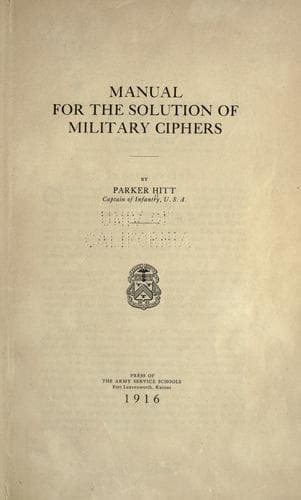
Manual for the Solution of Military CiphersHitt, Parker
History
Manual for the Solution of Military Ciphers
Hitt, Parker
Ciphers; Cryptography
The transmission of cipher text over the telegraph or by radio is
a slow process, and many fairly good operators cannot receive such
matter satisfactorily, because they listen for words and guess at
letters at times. The spaced letters in American Morse are the cause
of so many errors in code transmission that the War Department Code
does not employ any groups using them. In fact, this code is limited
to the letters
A B D E F G I K M N S T U X
so that there may be a minimum of such confusion.
In cipher work it is necessary, under ordinary circumstances, to
use any or all of the letters of the alphabet. To assist operators
in keeping the text straight, it is customary to divide cipher text
into groups of four, five, six or ten letters, and usually groups of
five letters are used. The receiving operator may then expect five
letters per group, and if he receives more or less he is sure that
either he or the sending operator has made an error. This division
into groups of a constant number of letters eliminates word forms and,
in the mind of the non-expert, increases the difficulty of solving the
cipher. But the increase in difficulty is more apparent than real;
particularly, as a cipher examiner habitually finds himself dealing
with ciphers without word forms, and the occurrence of a cipher with
word forms usually means that he has an easy one to handle.
Messages are occasionally encountered which consist partly of plain
text and partly of cipher. The cipher part may or may not retain its
word forms, but, when this method is used, it is clearly impossible
to have a fixed number of letters in each cipher group if the word
forms are not used. It is almost impossible to prevent errors of
transmission in such messages, and it often requires considerable
skill and labor to correct them.
For those unfamiliar with the telegraph alphabets, they are given
below. Messages sent by commercial or military telegraphs or buzzer
lines will be transmitted with the American Morse alphabet. Those sent
by radio, visual signalling or submarine cable will be transmitted
by Continental Morse, known also as the International Code. Messages
may be transmitted by both alphabets in course of transmission. For
example, a cablegram from the Philippines to Nome, Alaska, will be
transmitted by Continental Morse (commercial cable) from Manila to San
Francisco, by American Morse (commercial land line) from San Francisco
to Seattle, by Continental Morse (military cable) from Seattle to
Valdez, by American Morse (military land line) from Valdez to Nulato
and by Continental Morse (military radio) from Nulato to Nome.
Public-domain text, read in full here on John Shaqi.
Reviews
Reviews
No reviews yet
Be the first to share your thoughts on this work.
Elsewhere in the archive
Join the Discussion
Join the discussion
Sign in to leave a comment or review.
Sign InorCreate an account