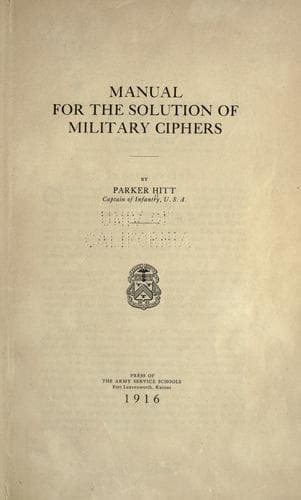
Manual for the Solution of Military CiphersHitt, Parker
History
Manual for the Solution of Military Ciphers
Hitt, Parker
Ciphers; Cryptography
TH 50 AT 25 ST 20
ER 40 EN 25 IO 18
ON 39 ES 25 LE 18
AN 38 OF 25 IS 17
RE 36 OR 25 OU 17
HE 33 NT 24 AR 16
IN 31 EA 22 AS 16
ED 30 TI 22 DE 16
ND 30 TO 22 RT 16
HA 26 IT 20 VE 16
Table V.--Table of recurrence of groups of three letters to be expected
in a count of 10,000 letters of English text.
THE 89 TIO 33 EDT 27
AND 54 FOR 33 TIS 25
THA 47 NDE 31 OFT 23
ENT 39 HAS 28 STH 21
ION 36 NCE 27 MEN 20
Table VI.--Table of frequency of occurrence of letters as initials
and finals of English words. Based on a count of 4,000 words; this
table gives the figures for an average 100 words and is necessarily
an approximation, like Table III. English words are derived from so
many sources that it is not impossible for any letter to occur as an
initial or final of a word, although Q, X and Z are rare as initials
and B, I, J, Q, V, X and Z are rare as finals.
Letters A B C D E F G H I J K L M N O P Q R S T U V W X Y Z
Initial 9 6 6 5 2 4 2 3 3 1 1 2 4 2 10 2 - 4 5 17 2 - 7 - 3 -
Final 1 - - 10 17 6 4 2 - - 1 6 1 9 4 1 - 8 9 11 1 - 1 - 8 -
It is practically impossible to find five consecutive letters in an
English text without a vowel and we may expect from one to three with
two as the general average. In any twenty letters we may expect to
find from 6 to 9 vowels with 8 as an average. Among themselves the
relative frequency of occurrence of each of the vowels, (including
Y when a vowel) is as follows:
A, 19.5% E, 32.0% I, 16.7%
O, 20.2% U, 8.0% Y, 3.6%
The foregoing tables give all the essential facts about the mechanism
of the English language from the standpoint of the solution of
ciphers. The use to be made of these tables will be evident when the
solution of different types of ciphers is taken up.
Data for the Solution of Ciphers in Spanish
The Spanish language is written with the following alphabet:
A B C CH D E F G H I J L LL
M N Ñ O P Q R RR S T U V X Y Z
while the exact sense often depends upon the use of accents over the
vowels. However, in cipher work it is exceedingly inconvenient to use
the permanent digraphs, CH, LL and RR and they do not appear as such in
any specimens of Spanish or Mexican cipher examined. Accented vowels
and Ñ are also not found and we may, in general, say that a cipher
whose text is Spanish will be prepared with the following alphabet:
Public-domain text, read in full here on John Shaqi.
Reviews
Reviews
No reviews yet
Be the first to share your thoughts on this work.
Join the Discussion
Join the discussion
Sign in to leave a comment or review.
Sign InorCreate an account