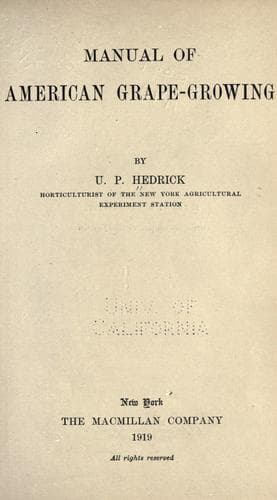
Grapes -- Varieties -- United States; Viticulture -- United States
These considerations of length of season, humidity and spring and fall
frosts make it plain that the grape-grower must synchronize these
phases of climate with the life events of the grape. In particular, he
must study weather data in relation to the blooming and ripening of
grapes. Usually, the necessary weather data may be secured from the
nearest local weather bureau, while the date of blooming and ripening
may be obtained from the state experiment stations in the states where
the grape is an important crop.
_Winter temperature._
Varieties of native grapes are seldom injured in America by
winter-killing, since they are usually planted in climates in which
wild grapes withstand winter conditions. Native varieties follow the
rule that plant and climate are truly congenial in regions in which
the plant thrives without the aid of man. A few varieties of native
grapes fare badly in the winter's cold of northern grape regions, and
the tender Vinifera vine is at the mercy of the winter wherever the
mercury goes below zero. In cold climates, therefore, care must be
exercised in selecting hardy varieties and in following careful
cultural methods with the tender sorts. If other climatic conditions
are favorable, however, winter-killing is not an unsurmountable
difficulty, since the grape is easily protected from cold, so easily
that the tender Viniferas may be grown in the cold North with winter
protection.
_Air currents._
Currents of air are of but local importance in growing tree-fruits,
but are of general and vital importance in growing the grape. The
direction, force and frequency of prevailing winds are often
controlling factors in the suppression of fungous diseases of the
grape, and the presence of fungi often means success or failure in
regions in which the grape is planted. Winds are beneficial, too, when
they bring warm air or dry air, and when they keep frosty air in
motion. The air must move in all grape regions, whether from canon,
mountain, lake or sea. Sunlight, warmth, and air in motion are life to
the grape. Sometimes winds may be detrimental; as when too cold, too
blustering, or when they bring hail, the latter being about the most
disastrous of all natural calamities. Windbreaks are of small value
and are often worse than useless. Having planted his vineyard, the
grape-grower must take the winds as they blow.
_Soils for grapes_
Public-domain text, read in full here on John Shaqi.
Reviews
Reviews
No reviews yet
Be the first to share your thoughts on this work.
Join the Discussion
Join the discussion
Sign in to leave a comment or review.
Sign InorCreate an account