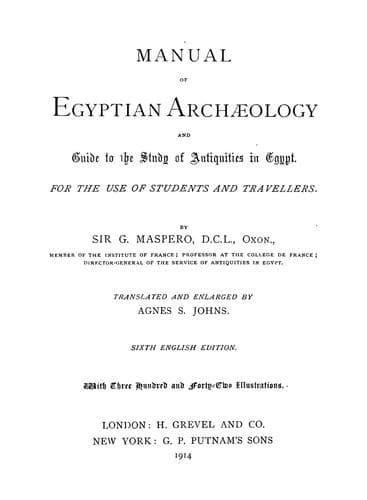
Manual of Egyptian Archaeology and Guide to the Study of Antiquities in EgyptMaspero, G. (Gaston)
History
Manual of Egyptian Archaeology and Guide to the Study of Antiquities in Egypt
Maspero, G. (Gaston)
Art -- Egypt; Egypt -- Antiquities
[42] The classic Syene, from all time the southernmost portion of Egypt
proper. The Sixth Dynasty is called the Elephantine, from the island
immediately facing Syene which was the traditional seat of the
Dynasty, and on which the temples stood. The tombs of Elephantine were
discovered by General Sir F. Grenfell, K.C.B., in 1885, in the
neighbouring cliffs of the Libyan Desert: see foot-note p. 149.--
A.B.E.
[43] For an explanation of the nature of the Double, see Chapter III., pp.
111-112, 121 _et seq._
[44] Known as the "Scribe accroupi," literally the "Squatting Scribe"; but
in English, squatting, as applied to Egyptian art, is taken to mean
the attitude of sitting with the knees nearly touching the chin.
--A.B.E.
[45] "The Sheikh of the Village." This statue was best known in England as
the "Wooden Man of Bûlak."--A.B.E.
[46] The Greek Chephren.
[47] I venture to think that the heads of Rahotep and Nefert, engraved from
a brilliant photograph in _A Thousand Miles up the Nile_, give a
truer and more spirited idea of the originals than the present
illustrations,--A.B.E.
[48] That is, the Eighteenth, Nineteenth, and Twentieth Dynasties.
--A.B.E.
[49] According to the measurements given by Mr. Petrie, who discovered the
remains of the Tanite colossus, it must have stood ninety feet high
without, and one hundred and twenty feet high with, its pedestal. See
_Tanis_, Part I., by W.M.F. Petrie, published by the Egypt
Exploration Fund, 1885.--A.B.E.
[50] Ameniritis, daughter of an Ethiopian king named Kashta, was the sister
and successor of her brother Shabaka, and wife of Piankhi II., Twenty-
fifth Dynasty. The statue is in alabaster.--A.B.E.
[51] A Memphite scribe of the Thirtieth Dynasty.--A.B.E.
[52] In Egyptian _Ta-ûrt_, or "the Great;" also called _Apet_.
This goddess is always represented as a hippopotamus walking. She
carries in each hand the emblem of protection, called "_Sa_." The
statuette of the illustration is in green serpentine.--A.B.E.
[53] _Sebakh_, signifying "salt," or "saltpetre," is the general
term for that saline dust which accumulates wherever there are mounds
of brick or limestone ruins. This dust is much valued as a manure, or
"top-dressing," and is so constantly dug out and carried away by the
natives, that the mounds of ancient towns and villages are rapidly
undergoing destruction in all parts of Egypt.--A.B.E.
[54] For an example of Graeco-Egyptian portrait painting, _tempo_
Hadrian, see p. 291.
CHAPTER V.
_THE INDUSTRIAL ARTS._
Public-domain text, read in full here on John Shaqi.
Reviews
Reviews
No reviews yet
Be the first to share your thoughts on this work.
Elsewhere in the archive
Join the Discussion
Join the discussion
Sign in to leave a comment or review.
Sign InorCreate an account