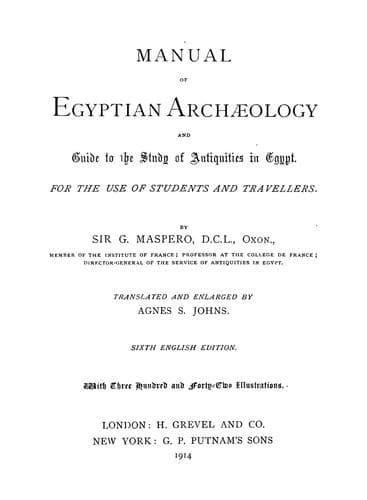
Manual of Egyptian Archaeology and Guide to the Study of Antiquities in EgyptMaspero, G. (Gaston)
History
Manual of Egyptian Archaeology and Guide to the Study of Antiquities in Egypt
Maspero, G. (Gaston)
Art -- Egypt; Egypt -- Antiquities
I have treated briefly of the Noble Arts; it remains to say something of
the Industrial Arts. All classes of society in Egypt were, from an early
period, imbued with the love of luxury, and with a taste for the beautiful.
Living or dead, the Egyptian desired to have jewels and costly amulets upon
his person, and to be surrounded by choice furniture and elegant utensils.
The objects of his daily use must be distinguished, if not by richness of
material, at least by grace of form; and in order to satisfy his
requirements, the clay, the stone, the metals, the woods, and other
products of distant lands were laid under contribution.
I.--STONE, CLAY, AND GLASS.
[Illustration: Fig. 210.--The _Ta_, or girdle-buckle of Isis.]
[Illustration: Fig. 211.--Frog amulet.]
[Illustration: Fig. 212.--The _Ûat_, or lotus-column amulet.]
[Illustration: Fig. 213.--An _Ûta_, or sacred eye.]
[Illustration: Fig. 214.--A scarabaeus.]
It is impossible to pass through a gallery of Egyptian antiquities without
being surprised by the prodigious number of small objects in _pietra dura_
which have survived till the present time. As yet we have found neither the
diamond, the ruby, nor the sapphire; but with these exceptions, the domain
of the lapidary was almost as extensive as at the present day. That domain
included the amethyst, the emerald, the garnet, the aquamarine, the
chrysoprase, the innumerable varieties of agate and jasper, lapis lazuli,
felspar, obsidian; also various rocks, such as granite, serpentine, and
porphyry; certain fossils, as yellow amber and some kinds of turquoise;
organic remains, as coral, mother-of-pearl, and pearls; metallic ores and
carbonates, such as hematite and malachite, and the calaite, or Oriental
turquoise. These substances were for the most part cut in the shape of
round, square, oval, spindle-shaped, pear-shaped, or lozenge-shaped beads.
Strung and arranged row above row, these beads were made into necklaces,
and are picked up by myriads in the sands of the great cemeteries at
Memphis, Erment, Ekhmîm, and Abydos. The perfection with which many are
cut, the deftness with which they are pierced, and the beauty of the
polish, do honour to the craftsmen who made them. But their skill did not
end here. With the point, saw, drill, and grindstone, they fashioned these
materials into an infinity of shapes--hearts, human fingers, serpents,
animals, images of divinities. All these were amulets; and they were
probably less valued for the charm of the workmanship than for the
supernatural virtues which they were supposed to possess. The girdle-buckle
in carnelian (fig. 210) symbolised the blood of Isis, and washed away the
sins of the wearer. The frog (fig. 211) was emblematic of renewed birth.
The little lotus-flower column in green felspar (fig. 212) typified the
divine gift of eternal youth. The "Ûat," or sacred eye (fig. 213), tied to
the wrist or the arm by a slender string, protected against the evil eye,
Public-domain text, read in full here on John Shaqi.
Reviews
Reviews
No reviews yet
Be the first to share your thoughts on this work.
Elsewhere in the archive
Join the Discussion
Join the discussion
Sign in to leave a comment or review.
Sign InorCreate an account