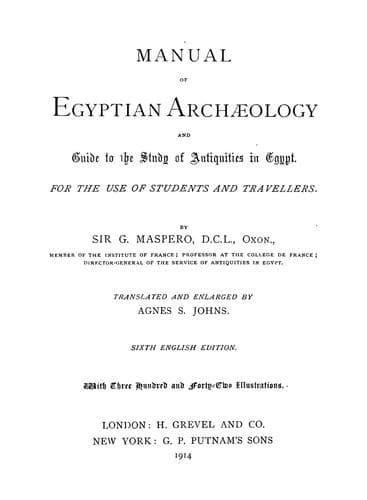
Manual of Egyptian Archaeology and Guide to the Study of Antiquities in EgyptMaspero, G. (Gaston)
History
Manual of Egyptian Archaeology and Guide to the Study of Antiquities in Egypt
Maspero, G. (Gaston)
Art -- Egypt; Egypt -- Antiquities
To put this book into English, and thus to hand it on to thousands who
might not otherwise have enjoyed it, has been to me a very congenial and
interesting task. It would be difficult, I imagine, to point to any work of
its scope and character which is better calculated to give lasting delight
to all classes of readers. For the skilled archaeologist, its pages contain
not only new facts, but new views and new interpretations; while to those
who know little, or perhaps nothing, of the subjects under discussion, it
will open a fresh and fascinating field of study. It is not enough to say
that a handbook of Egyptian Archaeology was much needed, and that Professor
Maspero has given us exactly what we required. He has done much more than
this. He has given us a picturesque, vivacious, and highly original volume,
as delightful as if it were not learned, and as instructive as if it were
dull.
As regards the practical side of Archaeology, it ought to be unnecessary to
point out that its usefulness is strictly parallel with the usefulness of
public museums. To collect and exhibit objects of ancient art and industry
is worse than idle if we do not also endeavour to disseminate some
knowledge of the history of those arts and industries, and of the processes
employed by the artists and craftsmen of the past. Archaeology, no less
than love, "adds a precious seeing to the eye"; and without that gain of
mental sight, the treasures of our public collections are regarded by the
general visitor as mere "curiosities"--flat and stale for the most part,
and wholly unprofitable.
I am much indebted to Mr. W.M. Flinders Petrie, author of _The Pyramids and
Temples of Gizeh_, for kindly translating the section on "Pyramids," which
is entirely from his pen. I have also to thank him for many valuable notes
on subjects dealt with in the first three chapters. To avoid confusion, I
have numbered these notes, and placed them at the end of the volume.
My acknowledgments are likewise due to Professor Maspero for the care with
which he has read the proof-sheets of this version of his work. In
departing from his system of orthography (and that of Mr. Petrie) I have
been solely guided by the necessities of English readers. I foresee that
_Egyptian Archaeology_ will henceforth be the inseparable companion of all
English-speaking travellers who visit the Valley of the Nile; hence I have
for the most part adopted the spelling of Egyptian proper names as given by
the author of "Murray's Handbook for Egypt."
Touching my own share in the present volume, I will only say that I have
tried to present Professor Maspero's inimitable French in the form of
readable English, rather than in a strictly word-for-word translation; and
that with the hope of still further extending the usefulness of the book, I
have added some foot-note references.
AMELIA B. EDWARDS.
WESTBURY-ON-TRYM,
_August_, 1887.
CONTENTS.
CHAPTER I.
ARCHITECTURE--CIVIL AND MILITARY.
Public-domain text, read in full here on John Shaqi.
Reviews
Reviews
No reviews yet
Be the first to share your thoughts on this work.
Join the Discussion
Join the discussion
Sign in to leave a comment or review.
Sign InorCreate an account