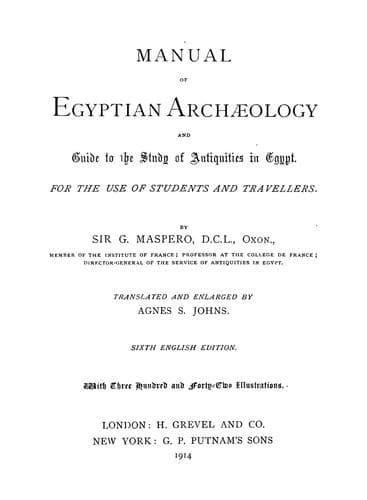
Manual of Egyptian Archaeology and Guide to the Study of Antiquities in EgyptMaspero, G. (Gaston)
History
Manual of Egyptian Archaeology and Guide to the Study of Antiquities in Egypt
Maspero, G. (Gaston)
Art -- Egypt; Egypt -- Antiquities
When space permitted, the vault was excavated immediately below the chapel.
The shaft was sometimes sunk in a corner of one of the chambers, and
sometimes outside, in front of the door of the tomb. In the great
cemeteries, as for instance at Thebes and Memphis, the superposition of
these three parts--the chapel, the shaft, and the vault--was not always
possible. If the shaft were carried to its accustomed depth, there was
sometimes the risk of breaking into tombs excavated at a lower level. This
danger was met either by driving a long passage into the rock, and then
sinking the shaft at the farther end, or by substituting a slightly sloping
or horizontal disposition of the parts for the old vertical arrangement of
the mastaba model. The passage in this case opens from the centre of the
end wall, its average length being from 20 to 130 feet. The sepulchral
vault is always small and plain, as well as the passage. Under the Theban
dynasties, as under the Memphite kings, the Soul dispensed with
decorations; but whenever the walls of the vault are decorated, the figures
and inscriptions are found to relate chiefly to the life of the Soul, and
very slightly to the life of the Double. In the tomb of Horhotep, which is
of the time of the Ûsertesens, and in similar rock-cut sepulchres, the
walls (except on the side of the door) are divided into two registers. The
upper row belongs to the Double, and contains, besides the table of
offerings, pictured representations of the same objects which are seen in
certain mastabas of the Sixth Dynasty; namely, stuffs, jewels, arms, and
perfumes, all needful to Horhotep for the purpose of imparting eternal
youth to his limbs. The lower register belonged to both the Soul and the
Double, and is inscribed with extracts from a variety of liturgical
writings, such as _The Book of the Dead_, the _Ritual of Embalmment_, and
the _Funeral Ritual_, all of which were possessed of magic properties which
protected the Soul and supported the Double. The stone sarcophagus, and
even the coffin, are also covered with closely-written inscriptions.
Precisely as the stela epitomised the whole chapel, so did the sarcophagus
and coffin epitomise the sepulchral chamber, thus forming, as it were, a
vault within a vault. Texts, tableaux, all thereon depicted, treat of the
life of the Soul, and of its salvation in the world to come.
Public-domain text, read in full here on John Shaqi.
Reviews
Reviews
No reviews yet
Be the first to share your thoughts on this work.
Elsewhere in the archive
Join the Discussion
Join the discussion
Sign in to leave a comment or review.
Sign InorCreate an account