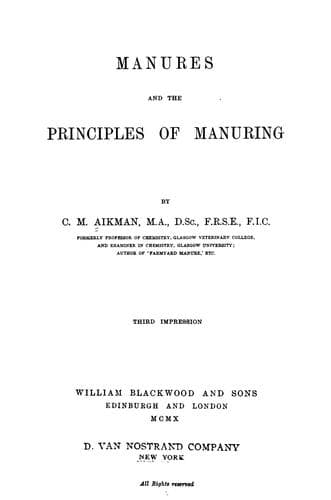
Manures and the principles of manuringAikman, Charles Morton
Science
Manures and the principles of manuring
Aikman, Charles Morton
Fertilizers; Manures
Phosphate soluble in water 100
Phosphate soluble in ammonium citrate 94
Fine bone-dust, powdered fish 94
Fine medium bone 74
Medium bone 60
Coarse bone 40
CHAPTER XIV.
THOMAS-PHOSPHATE OR BASIC SLAG.
In this substance we have a most important addition to our phosphatic
manures. It has been in the market since 1886, and the consumption alone
in Germany in 1887 amounted to nearly 300,000 tons. In this country it
is only now beginning to be used to any extent.
_Its Manufacture._
_Thomas-slag_ is a bye-product obtained in the manufacture of steel by
what is known as the "basic" process. In the year 1879 an improvement in
the well-known "Bessemer" process was patented by Messrs Gilchrist &
Thomas. It must be explained that in the manufacture of steel from
pig-iron certain impurities in the raw material have to be got rid of in
order to produce a good steel. Among these impurities one of the most
important is _phosphorus_. This is owing to the fact that even a very
small percentage of phosphoric acid in steel has the effect of
rendering it brittle. The extraction of the phosphorus from the raw
material was formerly, however, attended with very serious difficulties,
and had the effect naturally of rendering steel a costly article,
inasmuch as only the purer kinds of pig-iron could be used for the
purpose.
By the introduction in 1879, however, of the "Thomas-Gilchrist" or
"basic" process, these difficulties were very largely overcome, and the
employment of even such impure irons as the Cleveland (containing
comparatively a large percentage of phosphorus) was rendered possible,
and the price of steel consequently generally very much reduced. The
process consists of submitting the molten pig-iron to a very great heat
in a pear-shaped vessel (known technically as the "converter"). This is
open at the top, and is supported on hinges, which permit of its being
moved so as to pour off the scum which rises to the surface at the end
of the operation, and which, we may explain, consists of "basic slag."
In the original process the sides of the "converter" were lined with
fire-bricks, consisting largely of silica. This process was known as the
"acid" process. In the "Thomas-Gilchrist" process, however, the sides of
the "converter" are lined with _lime_ (dolomitic limestone being largely
used), lime being also added to the pig-iron. An air-blast is injected
through the molten mass, and the impurities are burnt, or oxidised as it
is chemically termed. The phosphorus in the iron is thus converted into
phosphoric acid, and, uniting with the lime, forms phosphate of lime,
which rises, as we have already said, to the surface in the form of a
scum, and is separated from the steel by being poured off.
Public-domain text, read in full here on John Shaqi.
Reviews
Reviews
No reviews yet
Be the first to share your thoughts on this work.
Elsewhere in the archive
Join the Discussion
Join the discussion
Sign in to leave a comment or review.
Sign InorCreate an account