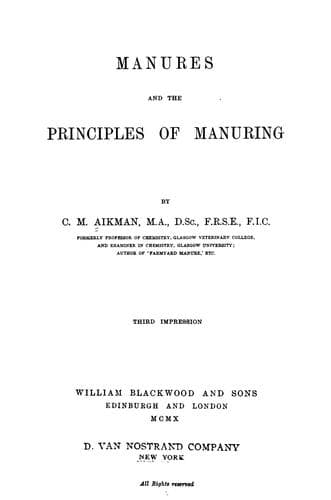
Manures and the principles of manuringAikman, Charles Morton
Science
Manures and the principles of manuring
Aikman, Charles Morton
Fertilizers; Manures
Another objection to irrigation has been found in the alleged limited
number of crops sewaged land is suited to yield. It has been repeatedly
stated that rye-grass is about the only crop it is profitable to grow
on it. In opposition to this statement, however, is the opinion
expressed in the conclusions arrived at by the committee appointed by
the British Association for the consideration of the sewage question. A
vast number of experiments were carried out by them between the years
1868-72, and the result they arrived at was as follows: "It is certain
that all kinds of crops may be grown with sewage, so that the farmer can
grow such as he can best sell; nevertheless, the staple crops must be
cattle food, such as grass, roots, &c., with occasional crops of kitchen
vegetables and of corn." While, therefore, it is probably a mistake to
say that rye-grass is the only crop sewaged land is capable of growing
profitably, the bulk of experience goes to show that such a crop is best
suited for such land. This being so, the question naturally arises, What
is the farmer who uses sewage as a manure to do with the large green
crops he obtains from his land? He is, in most cases, unable to use them
himself or dispose of them at the time. And while this has hitherto
proved to be a most important drawback, now that we have in ensilage a
means of preserving our green crops in a condition suitable as fodder
for as long a time as is necessary, the grounds on which this objection
rests are almost entirely removed.
Public-domain text, read in full here on John Shaqi.
Reviews
Reviews
No reviews yet
Be the first to share your thoughts on this work.
Elsewhere in the archive
Join the Discussion
Join the discussion
Sign in to leave a comment or review.
Sign InorCreate an account