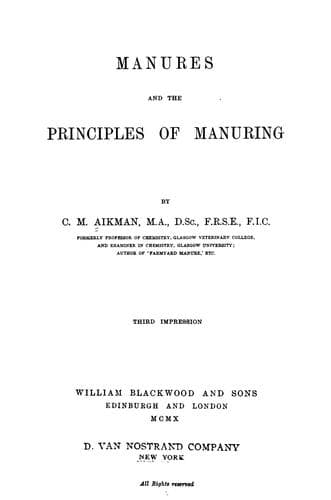
Manures and the principles of manuringAikman, Charles Morton
Science
Manures and the principles of manuring
Aikman, Charles Morton
Fertilizers; Manures
It will be obvious, of course, that some soils are naturally much better
fitted to perform purification of sewage than others; but it must be
frankly admitted that even the best of soils can only deal with a
certain quantity of sewage. Various calculations have been indulged in
as to the amount of sewage an acre of land can successfully deal with.
According to one of these, an acre can purify some 2000 gallons per day,
or that produced by 100 persons; while other calculations estimate it at
60 persons; and others, again, at 150. The capacity of a sandy soil in
this respect will be much greater than that of a heavier soil; and at
Dantzic an acre of the sand-dunes is regarded as being capable of
purifying the sewage of 600 persons. The late Dr Wallace has calculated
that, in order to treat the sewage of Glasgow, over twelve square miles
of land would be required. Of course, if the sewage is subjected to
previous treatment, which is often the case, by the method immediately
about to be described--namely, precipitation--the amount of sewage the
soil is capable of purifying will be correspondingly increased. A
difficulty which may also be pointed out in connection with irrigation
as a means of disposing of sewage, is the impossibility of carrying it
on during frosty weather, when the land is frost-bound. In warm climates
irrigation has much to recommend it as a means of sewage disposal. In
damp and cold climates, on the other hand, there are many objections.
_Treatment of Sewage by Precipitation, &c._
We now come to consider the methods grouped under this second heading.
Mechanical filtration, of course, only aims at purifying sewage to the
extent of removing all insoluble suspended matter which it contains.
Different substances have been used as filters, the most generally used
being charcoal. Charcoal mixed with burnt clay, gravel, sand, &c., has
also been used.
In chemical precipitation, however, we have a method which claims to do
more. Beyond the extracting of all solid matters in suspension, it
removes (at any rate most chemical precipitants do) nearly all the
phosphoric acid, which, next to the ammonia, is the most valuable
constituent the sewage contains. Of all precipitants, lime has been the
most universally used; and on the whole, it is perhaps the best, for it
is both cheap and obtainable almost anywhere. According to an analysis
by the late Professor Way, the difference in the percentages of
phosphoric acid, potash, and ammonia, before and after treatment with
lime, in a sample of sewage, was as follows:--
_Grains per Gallon._
Before. After.
Phosphoric acid 2.63 .45
Potash 3.66 3.80
Ammonia 7.48 7.50
Public-domain text, read in full here on John Shaqi.
Reviews
Reviews
No reviews yet
Be the first to share your thoughts on this work.
Elsewhere in the archive
Join the Discussion
Join the discussion
Sign in to leave a comment or review.
Sign InorCreate an account