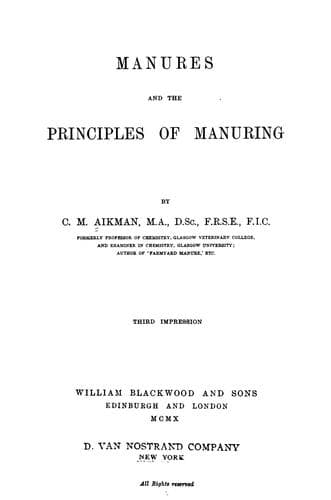
Manures and the principles of manuringAikman, Charles Morton
Science
Manures and the principles of manuring
Aikman, Charles Morton
Fertilizers; Manures
Despite the fact of the long-established and almost universal use of
lime, it can scarcely be said that we as yet clearly understand the
exact nature of its action. Much light, however, has been thrown of late
years on the subject by the great advance which has been made in our
knowledge of agricultural chemistry. Nevertheless, there are many points
connected with the action of lime on the soil which are still obscure.
Perhaps one reason for the conflicting ideas prevalent with regard to
the value of this substance in agriculture is to be found in the fact
that it acts in such a number of different ways, and that the nature of
the changes it gives rise to in the soil is most complicated. The
experience of agriculturists with lime in one part of the country often
seems contradictory to the experience of those in other parts of the
country. Its action on different soils is very dissimilar. For these
reasons, therefore, the discussion of the value of lime as a manure is
by no means an easy one.
_Lime a necessary Plant-food._
Lime, as we have already pointed out in a former chapter, is a necessary
plant-food, and were it present in the soil to a less extent than is
actually the case, would be just as valuable a manure as the different
nitrogenous and phosphatic manures; and in certain circumstances this is
the case. There are soils, though they are by no means of common
occurrence, which actually lack sufficient lime for supporting
plant-growth, and to which its addition directly promotes the growth of
the crop. Poor sandy soils are often of this nature. Another class of
soils are also apt to be lacking in lime--at any rate their surface-soil
is. These are permanent pasture-soils. Originally there may have been an
abundance of lime in the surface portion of the soil; but, as is well
known to every practical farmer, lime has a tendency to sink down in the
soil. This tendency in ordinary arable soils is largely counteracted by
ordinary tillage operations, such as ploughing, &c., by means of which
the lime is again brought to the surface. In permanent pasture-soils,
however, no such counteracting action takes place, hence impoverishment
of the surface-soil in lime eventually results. It is for this
reason--partly at any rate--that permanent pasture benefits in an
especial degree by the application of lime. We say _partly_, for there
are other important reasons. One is, that lime seems to have a striking
effect in improving the quality of pastures by inducing the finer
grasses to predominate. It has also a very favourable action in
promoting the growth of white clover. Another reason for the favourable
effect of lime on pasture-soils is doubtless on account of the action it
has in setting potash free from its compounds. Soils, however, which
directly benefit from the application of lime in the same way as they
benefit from the application of nitrogenous manures, may be safely said
to be rare.
Public-domain text, read in full here on John Shaqi.
Reviews
Reviews
No reviews yet
Be the first to share your thoughts on this work.
Elsewhere in the archive
Join the Discussion
Join the discussion
Sign in to leave a comment or review.
Sign InorCreate an account