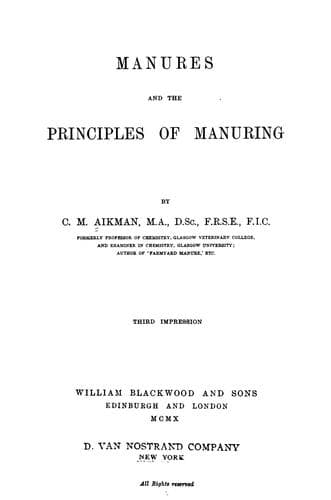
Manures and the principles of manuringAikman, Charles Morton
Science
Manures and the principles of manuring
Aikman, Charles Morton
Fertilizers; Manures
In the great majority of soils lime exists, so far as the
demands of plant-life are concerned, in superabundance.
_Lime of abundant Occurrence._
Indeed limestone is one of the most abundant of all rock substances, and
it has been calculated that it forms not less than one-sixth of the
rock-mass of the earth's crust. Nearly all the commonly occurring
minerals contain it, and in the course of their disintegration furnish
it to the soil. Vast tracts of country are composed of nothing but
limestone; and we have examples, even in this country, of so-called
chalk-soils, where it is the most abundant constituent. Nor can it be
classed amongst the insoluble mineral constituents of the soil; for
although insoluble in pure water, it is soluble in water--such as the
soil-water--which contains carbonic acid. This is proved by the fact
that it is the chief dissolved mineral ingredient in all natural waters.
_Lime returned to the Soil in ordinary Agricultural Practice._
It may be further pointed out, as bearing upon the true function of lime
when applied as a manure, that in ordinary agricultural practice nearly
all the lime removed from the soil in crops finds its way back again to
the farm in the straw of the farmyard manure. For these reasons, then,
it is clear that the true function of lime is as an indirect manure.
Let us now proceed to discuss its action. Before doing so, however, it
is important that we should clearly understand the different chemical
forms in which it occurs.
_Different Forms of Lime._
Lime occurs chiefly as carbonate of lime in the forms of limestone,
marble, or chalk, which are all chemically the same. It occurs also as
sulphate of lime or gypsum, as well as in the forms of phosphate and
fluoride. In agriculture it is only used--if we except the phosphate,
which is applied not on account of its lime, but its phosphoric acid--in
the form of the carbonate or _mild_ lime as it is commonly called,
burnt, caustic, or quick lime, and as gypsum. As the value of gypsum as
a manure is of such importance, and depends not entirely on its being a
compound of lime, we shall consider it by itself. Hence we have only to
consider here the action of mild and caustic lime.
_Caustic Lime._
When limestone or mild lime is submitted to a great heat, such as is
practically done on a large scale in lime-kilns, it is converted into
caustic lime or lime proper. Limestone is made up, as we have just
mentioned, of lime and carbonic acid. The latter ingredient is expelled
in the form of a gas, and the lime is left behind. Lime never occurs
naturally as caustic lime, for the simple reason that it is impossible
for it to remain in this state, owing to the great affinity it has both
for water and carbonic acid.
Public-domain text, read in full here on John Shaqi.
Reviews
Reviews
No reviews yet
Be the first to share your thoughts on this work.
Elsewhere in the archive
Join the Discussion
Join the discussion
Sign in to leave a comment or review.
Sign InorCreate an account