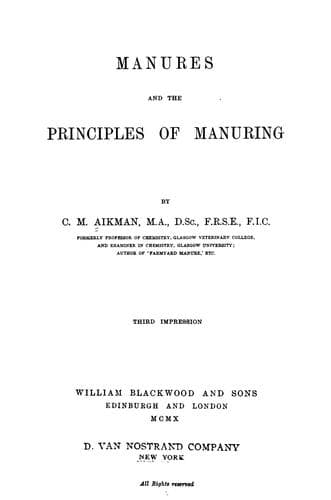
Manures and the principles of manuringAikman, Charles Morton
Science
Manures and the principles of manuring
Aikman, Charles Morton
Fertilizers; Manures
The last way in which lime acts is what we have termed biological. By
this we mean the important _role_ lime plays in promoting or retarding,
as the case may be, the various kinds of fermentative action which go on
so abundantly in all soils. The presence of carbonate of lime in the
soil is a necessary condition for the process of nitrification. Lime is
the base with which the nitric acid, when it is formed, combines; and as
we have seen, when discussing nitrification, soils of a chalky nature
are among those best suited to promote the natural formation of
nitrates. This is one of the reasons for the beneficial effects produced
by lime when applied to peaty soils. Not merely does it help to
decompose the organic matter so abundant in such soils, but it also
furnishes the base with which the nitric acid may combine when it is
formed. But while the action of lime is to promote fermentation, it must
not be forgotten that there may be cases in which its action is rather
the reverse of this. Fermentation of organic matter goes on when there
is a certain amount of alkalinity present; while, on the other hand, the
presence of acidity seems to retard and check it. Too great an amount of
alkalinity, however, would, in the first instance, retard fermentation
as much as too great acidity. It has been claimed that the addition of
caustic lime to fresh urine may act in this way; and if this were so,
the addition of lime to farmyard manure might, to a certain extent, be
defended. The experiment, however, would be a hazardous one and not to
be recommended, as loss of ammonia would most likely ensue.
_Action of Lime on Nitrogenous Organic Matter._
The action of lime on nitrogenous organic matter is of a very striking
kind, and is by no means very clearly understood. As we have pointed
out, it sometimes acts as an antiseptic or preservative; and this
antiseptic or preservative action has been explained on the assumption
that insoluble albuminates of lime are formed. Its action in such
industries as calico-printing, where it has been used along with casein
for fixing colouring matter; or in sugar-refining, where it is used for
clarifying the sugar by precipitating the albuminous matter in solution
in the saccharine liquor; or lastly, in purifying sewage,--has been
cited in support of this theory. While, however, there may be
circumstances in which lime, especially in its caustic form, acts as an
antiseptic, its general tendency is to promote these fermentative
changes, such as nitrification, so important to plant-life.
An important use of lime in agriculture is in preventing the action of
certain fungoid diseases, such as "rust," "smut," "finger-and-toe," &c.,
as well as in killing, as every horticulturist and farmer knows, slugs,
&c.
_Recapitulation._
Public-domain text, read in full here on John Shaqi.
Reviews
Reviews
No reviews yet
Be the first to share your thoughts on this work.
Elsewhere in the archive
Join the Discussion
Join the discussion
Sign in to leave a comment or review.
Sign InorCreate an account