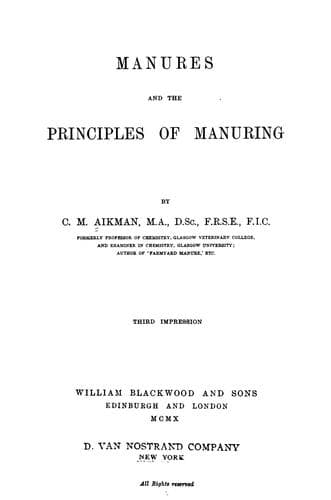
Manures and the principles of manuringAikman, Charles Morton
Science
Manures and the principles of manuring
Aikman, Charles Morton
Fertilizers; Manures
We may, in conclusion, sum up in a single paragraph the different ways
in which lime acts. Its action is mechanical, chemical, and biological.
It acts on the texture of the soil, rendering clay soils more friable,
and exerting a certain binding effect on loose soils. It decomposes the
minerals containing potash and other food-constituents, and renders them
available for the plant's needs. It further decomposes organic matter,
and promotes the important process of nitrification. It increases the
power of a soil to fix such valuable food-constituents as ammonia and
potash. It neutralises sourness, and prevents the formation of poisonous
compounds in the soil. It increases the capillary condition of the soil,
prevents fungoid diseases, and promotes the growth of the more nutritive
herbage in pasture-land.
CHAPTER XXI.
INDIRECT MANURES--GYPSUM, SALT, ETC.
GYPSUM.
In the previous chapter mention was made of gypsum as a compound of
lime, but no reference to its action as a manure was made. In the past,
gypsum was used extensively and highly valued. It was found to be of
especial value for clover; and there is a story told of Benjamin
Franklin which illustrates the very striking nature of its action on
this crop. It is related that he once printed with gypsum the words
"This has been plastered" on a field of clover, and that for a long time
afterwards the legend was plainly discernible on account of the
luxuriance of the clover on the parts of the field which had been thus
treated.
_Mode in which gypsum acts._
Public-domain text, read in full here on John Shaqi.
Reviews
Reviews
No reviews yet
Be the first to share your thoughts on this work.
Elsewhere in the archive
Join the Discussion
Join the discussion
Sign in to leave a comment or review.
Sign InorCreate an account