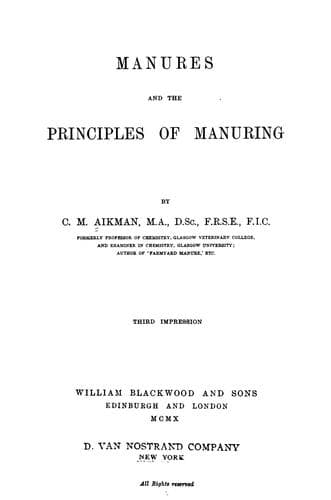
Manures and the principles of manuringAikman, Charles Morton
Science
Manures and the principles of manuring
Aikman, Charles Morton
Fertilizers; Manures
Gypsum, therefore, although it contains two necessary
plant-constituents, lime and sulphuric acid, cannot be regarded as a
direct manure; and as its action comes to be more fully understood, its
use, which was never very abundant in this country, will probably
decrease. We have already, in the chapter on Nitrification, referred to
the action of gypsum in promoting nitrification.
SALT.
The action of salt as a manure presents a problem which is at once of
the highest interest and surrounded with the greatest difficulties. In
view of the large quantities now used for agricultural purposes, a
somewhat detailed examination of the nature of its action is not out of
place in a work such as the present.
_Antiquity of the Use of Salt._
The recognition of the manurial functions of salt dates back to the very
earliest times. Its use among the ancients is testified by numerous
allusions in the Old Testament; while, according to Pliny, it was a
well-known manure in Italy. The Persians and the Chinese seem also to
have used it from time immemorial, the former more especially for
date-trees.
_Nature of its Action._
Despite, however, the great antiquity of its use, much difference of
opinion seems always to have existed as to the exact method of its
action, and as to its merits as a manure in promoting vegetable growth.
It furnishes, in fact, a good example of the difficulty which exists in
the case of many manures, whose action is chiefly indirect, of fully
understanding their influence on the soil and on the crop. In fact, the
action of salt is probably more complicated than that of any other
manurial substance.
_Salt not a necessary Plant-food._
We have already seen that neither sodium nor chlorine--the two
constituent elements of salt--are in all probability absolutely
necessary plant-foods. If they are necessary, the plant only requires
them in minute quantities. Despite this fact, soda is an ash-constituent
of nearly every plant, and in many cases one of the most abundant. In
amount it is one of the most variable of all the ash-constituents, being
present in some plants only in minute quantities, while in others it
occurs in large quantities. Mangel and plants of the cabbage tribe may
be cited as examples of plants containing large amounts of soda in their
composition. But the plants which contain it in largest quantity are
those which thrive on the sea-coast, and it has been thought that for
them at least salt is a necessary manure. This, however, does not seem
to be the case. In fact, the amount of soda in a plant seems to be
largely a matter of accident. It may be added that the succulent
portions of a plant are generally richest in soda.
_Can Soda replace Potash?_
Public-domain text, read in full here on John Shaqi.
Reviews
Reviews
No reviews yet
Be the first to share your thoughts on this work.
Elsewhere in the archive
Join the Discussion
Join the discussion
Sign in to leave a comment or review.
Sign InorCreate an account