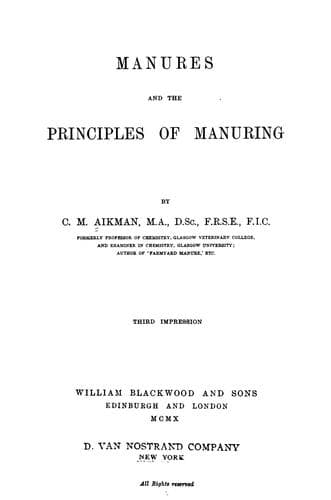
Manures and the principles of manuringAikman, Charles Morton
Science
Manures and the principles of manuring
Aikman, Charles Morton
Fertilizers; Manures
Again, it has been believed that soda is capable of replacing potash in
the plant; but this does not seem to be the case to any extent. The view
that soda is able to replace potash, it has been thought, is supported
by the variation which exists in the proportion of soda and potash in
different plants. It must be remembered, however, that it is highly
probable that most plants contain a larger quantity of ash-constituents
than is absolutely necessary for their healthy growth. Especially is
this the case with such a necessary plant-food as potash, of which there
is generally present, in all likelihood, an excess. The variation in the
quantity of potash and soda present in many plants under different
circumstances can scarcely, therefore, be regarded as furnishing a proof
of the replacement of potash by soda. Incidentally we may mention, as a
fact worthy of notice, that cultivated plants have more potash and less
soda in their composition than wild plants. What has been said of soda
may be held to apply equally to chlorine, as it seems to be chiefly in
the form of common salt that soda enters the plant. The amount of salt,
therefore, present in plants must be regarded as largely accidental and
dependent on external circumstances, such as the nature of the soil, &c.
_Salt of universal Occurrence._
But even were salt a necessary plant-food, its occurrence in the soil is
already of sufficient abundance to obviate any necessity for its
application. It may be said to be of almost universal occurrence. Even
the air contains it in traces. That this is the case in the
neighbourhood of the sea-coast is well known; but even in air far
inland, accurate analysis of the air would probably demonstrate its
presence in greater quantity than is commonly believed. It is a wise
provision that plants absorb salt, for it increases their efficiency as
food,--the function of salt as a constituent of animal food being of the
very highest importance. It is an indispensable food-ingredient for
animal life. With regard to ordinary farm-stock, the amount of salt
which naturally occurs in their food is quite sufficient. In the case,
however, of pastures in countries far removed from the sea, the custom
of specially supplying stock with salt is common. This is done by
placing a piece of rock-salt in the fields.
_Special Sources of Salt._
The salt of commerce is obtained from various sources. Besides the sea,
we have ample sources of salt in the large saline deposits found in many
parts of Europe, especially in Austria, and in England in Cheshire.
_The Action of Salt indirect._
From what has been said above, it is clear that the action of salt as a
manure is indirect and not direct. What the nature of that indirect
action is we shall now proceed to discuss.
Public-domain text, read in full here on John Shaqi.
Reviews
Reviews
No reviews yet
Be the first to share your thoughts on this work.
Elsewhere in the archive
Join the Discussion
Join the discussion
Sign in to leave a comment or review.
Sign InorCreate an account