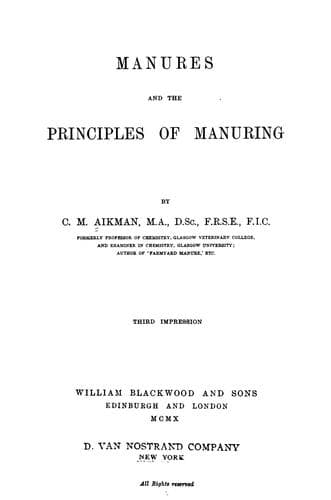
Manures and the principles of manuringAikman, Charles Morton
Science
Manures and the principles of manuring
Aikman, Charles Morton
Fertilizers; Manures
But a much more important property of salt is its solvent action on the
plant-food present in the soil. Its action in decomposing the minerals
containing lime, magnesia, potash, &c., is similar to the action of
gypsum. By acting upon the double silicates it liberates these necessary
plant-foods. It is not only on the basic substances upon which it acts,
but also on the phosphoric and silicic acids, which it sets free. Its
power of dissolving ammonia from the soil is considerable. Experiments
with a weak solution of salt on a soil by Peters and Eichhorn to test
its solvent power, showed that the salt solution dissolved more than
twice as much potash and nearly thirty times as much ammonia as an equal
quantity of pure water did. When applied to the soil, it seems chiefly
to liberate lime and magnesia. The exact nature of the chemical action
taking place is a point of some dubiety. According to some, it is
changed into nitrate of soda; according to others, into carbonate of
soda. The latter theory seems to be the more probable one. Its action on
the lime and magnesia compounds is to convert them into chlorides; and
this chemical reaction explains the action that salt has in increasing
the water-retaining and water-absorbing power of the soil; for the
chlorides of magnesia and lime are salts which have a great power of
attracting water from the air.
Again, the very fact that salt acts as an antiseptic may serve to
explain its beneficial action in certain cases where it prevents
rankness of growth. No doubt this was its function when applied along
with Peruvian guano. This it might do by preventing too rapid
fermentation (nitrification) of the manure, or by actually weakening the
plant. Its action when applied with farmyard manure may also be similar.
But while its effect in many cases may be towards retarding
fermentation, on the other hand its action, when applied along with lime
to compost-heaps, is towards promoting more rapid decomposition.
Probably a reaction takes place between the lime and the salt, the
result of which is the formation of caustic soda.
Such are some of the ways in which salt may act. It must at once be seen
how its action in one case will be favourable and in another case
unfavourable. There must be fertilising matter present in the soil if it
is to act favourably. Again, it will only be under such circumstances,
where rankness of growth is likely to ensue, that its antiseptic
properties will act favourably and not unfavourably.
_Best used in small Quantities along with Manures._
Public-domain text, read in full here on John Shaqi.
Reviews
Reviews
No reviews yet
Be the first to share your thoughts on this work.
Elsewhere in the archive
Join the Discussion
Join the discussion
Sign in to leave a comment or review.
Sign InorCreate an account