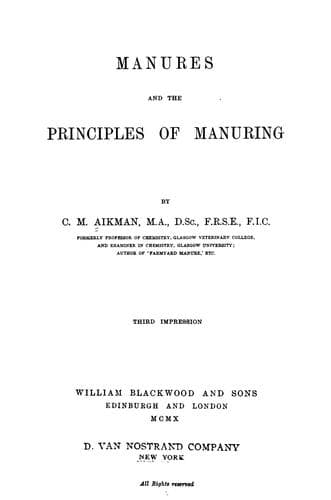
Manures and the principles of manuringAikman, Charles Morton
Science
Manures and the principles of manuring
Aikman, Charles Morton
Fertilizers; Manures
Probably it is for these reasons that its action has been found to be
most favourable when applied along with other manures and not alone.
Applied along with nitrate of soda, as is commonly done, it doubtless
increases the efficiency of the nitrate. Some plants seem to be
undoubtedly benefited by salt: of these flax may be mentioned. The
application of salt to plants of the cabbage tribe seems also to be
highly beneficial. On mangels, along with other manures, it has also
been found to have a very favourable effect. But with many crops its
action has been proved to be less favourable.
_Affects Quality of Crop._
Although salt has often been found to increase the quantity of a crop,
the quality of the crop has been made to suffer. Its action on beetroot
has been more especially studied. The effect of its application is to
lessen the total quantity of dry matter and sugar in the plant. This has
been found to be the case both when the salt was applied alone and along
with nitrate of soda and other manures. On potatoes, again, its action
has been found to be deleterious, lessening their percentage of starch.
The deleterious action of chlorides on the quality of potatoes is also
seen when potassium chloride is applied. It is for this reason that
potash should never be applied to the potato crop in the form of
chloride.
In the late Dr Voelcker's opinion, the conditions under which salt had
the most favourable action on the mangel crop was in the case of a light
sandy soil, and applied at the rate of 4 to 5 cwt. per acre. Its action
when applied to clay soils was not so favourable.
_Rate of Application._
Lastly, the rate at which it may be applied will naturally vary. From 1
cwt. and even less, up to 6 cwt. or even more, has been the rate at
which it has been commonly applied in the past. From what has been said,
it will be seen that it is more likely to exert a favourable influence
when applied only in small quantities.
CHAPTER XXII.
THE APPLICATION OF MANURES.
The conditions which regulate the application of manures are many and
varied, and the subject, it must be admitted, despite the large amount
of investigation already carried out, is most imperfectly understood.
For these reasons it is impossible to do little more than lay down
certain general principles which may be of service to the agriculturist
in guiding him in carrying out the manuring of his crops.
_Influence of Manures in increasing Soil-fertility._
Public-domain text, read in full here on John Shaqi.
Reviews
Reviews
No reviews yet
Be the first to share your thoughts on this work.
Elsewhere in the archive
Join the Discussion
Join the discussion
Sign in to leave a comment or review.
Sign InorCreate an account