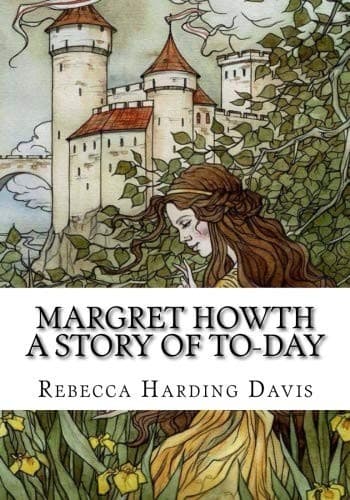
Margret Howth: A Story of To-dayDavis, Rebecca Harding
General
Margret Howth: A Story of To-day
Davis, Rebecca Harding
Fiction
The road was rough over the hills; the wind that struck Holmes's face
bitingly keen: perhaps the life coming for him would be as cold a
struggle, having not only poverty to conquer, but himself. But he is a
strong man,--no stronger puts his foot down with cool, resolute tread;
and to-night there is a thrill on his lips that never rested there
before,--a kiss, dewy and warm. Something, some new belief, too, stirs
in his heart, like a subtile atom of pure fire, that he hugs
closely,--his for all time. No poverty or death shall ever drive it
away. Perhaps he entertains an angel unaware.
After that night Lois never left her little shanty. The days that
followed were like one long Christmas; for her poor neighbors, black
and white, had some plot among themselves, and worked zealously to make
them seem so to her. It was easy to make these last days happy for the
simple little soul who had always gathered up every fragment of
pleasure in her featureless life, and made much of it, and rejoiced
over it. She grew bewildered, sometimes, lying on her wooden settle by
the fire; people lead always been friendly, taken care of her, but now
they were eager in their kindness, as though the time were short. She
did not understand the reason, at first; she did not want to die: yet
if it hurt her, when it grew clear at last, no one knew it; it was not
her way to speak of pain. Only, as she grew weaker, day by day, she
began to set her house in order, as one might say, in a quaint, almost
comical fashion, giving away everything she owned, down to her
treasures of colored bottles and needle-books, mending her father's
clothes, and laying them out in her drawers; lastly, she had Barney
brought in from the country, and every day would creep to the window to
see him fed and chirrup to him, whereat the poor old beast would look
up with his dim eye, and try to neigh a feeble answer. Kitts used to
come every day to see her, though he never said much when he was there:
he lugged his great copy of the Venus del Pardo along with him one day,
and left it, thinking she would like to look at it; Knowles called it
trash, when he came. The Doctor came always in the morning; he told
her he would read to her one day, and did it always afterwards, putting
on his horn spectacles, and holding her old Bible close up to his
rugged, anxious face. He used to read most from the Gospel of St.
John. She liked better to hear him than any of the others, even than
Margret, whose voice was so low and tender: something in the man's
half-savage nature was akin to the child's.
As the day drew near when she was to go, every pleasant trifle seemed
to gather a deeper, solemn meaning. Jenny Balls came in one night, and
old Mrs. Polston.
"We thought you'd like to see her weddin'-dress, Lois," said the old
woman, taking off Jenny's cloak, "seein' as the weddin' was to hev been
to-morrow, and was put off on 'count of you."
Public-domain text, read in full here on John Shaqi.
Reviews
Reviews
No reviews yet
Be the first to share your thoughts on this work.
Elsewhere in the archive
Join the Discussion
Join the discussion
Sign in to leave a comment or review.
Sign InorCreate an account