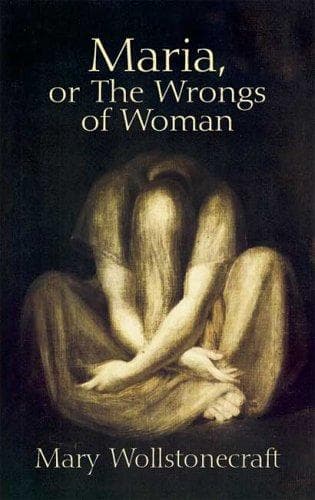
Maria; Or, The Wrongs of WomanWollstonecraft, Mary
General
Maria; Or, The Wrongs of Woman
Wollstonecraft, Mary
Autobiographical fiction; Feminist fiction; Women -- Fiction
“But, to pass over a subject which I recollect with pain, I must remark
to you, as an answer to your often-repeated question, ‘Why my
sentiments and language were superior to my station?’ that I now began
to read, to beguile the tediousness of solitude, and to gratify an
inquisitive, active mind. I had often, in my childhood, followed a
ballad-singer, to hear the sequel of a dismal story, though sure of
being severely punished for delaying to return with whatever I was sent
to purchase. I could just spell and put a sentence together, and I
listened to the various arguments, though often mingled with obscenity,
which occurred at the table where I was allowed to preside: for a
literary friend or two frequently came home with my master, to dine and
pass the night. Having lost the privileged respect of my sex, my
presence, instead of restraining, perhaps gave the reins to their
tongues; still I had the advantage of hearing discussions, from which,
in the common course of life, women are excluded.
“You may easily imagine, that it was only by degrees that I could
comprehend some of the subjects they investigated, or acquire from
their reasoning what might be termed a moral sense. But my fondness of
reading increasing, and my master occasionally shutting himself up in
this retreat, for weeks together, to write, I had many opportunities of
improvement. At first, considering money (I was right!” exclaimed
Jemima, altering her tone of voice) “as the only means, after my loss
of reputation, of obtaining respect, or even the toleration of
humanity, I had not the least scruple to secrete a part of the sums
intrusted to me, and to screen myself from detection by a system of
falshood. But, acquiring new principles, I began to have the ambition
of returning to the respectable part of society, and was weak enough to
suppose it possible. The attention of my unassuming instructor, who,
without being ignorant of his own powers, possessed great simplicity of
manners, strengthened the illusion. Having sometimes caught up hints
for thought, from my untutored remarks, he often led me to discuss the
subjects he was treating, and would read to me his productions,
previous to their publication, wishing to profit by the criticism of
unsophisticated feeling. The aim of his writings was to touch the
simple springs of the heart; for he despised the would-be oracles, the
self-elected philosophers, who fright away fancy, while sifting each
grain of thought to prove that slowness of comprehension is wisdom.
Public-domain text, read in full here on John Shaqi.
Reviews
Reviews
No reviews yet
Be the first to share your thoughts on this work.
Join the Discussion
Join the discussion
Sign in to leave a comment or review.
Sign InorCreate an account